


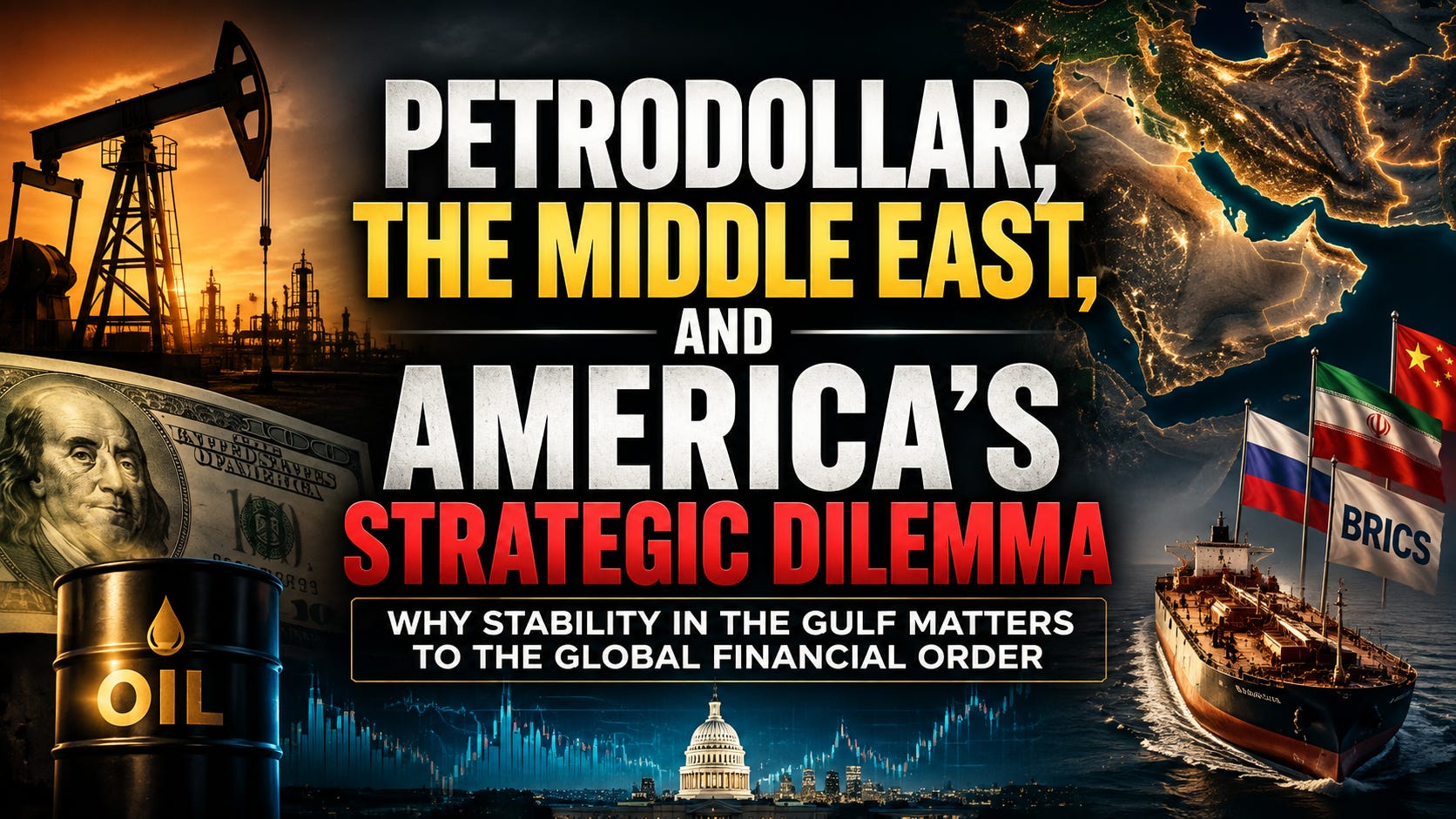
For more than five decades, the Middle East has been the cornerstone of global energy security and an important pillar of the international financial system. The PETRODOLLAR system, established in the 1970s, positioned the U.S. dollar as the principal currency for global oil trade, creating sustained international demand for dollars and reinforcing America’s financial influence.
Today, this system is gradually evolving. China is expanding the international use of the YUAN, Russia and Iran are increasingly conducting trade outside the dollar, and several BRICS nations are promoting local-currency settlements. While these developments do not signal the end of the U.S. dollar, they indicate a slow transition toward a more diversified global monetary system.
This report explores whether a major military conflict involving Iran could unintentionally accelerate this transition. It argues that large-scale destruction of Iran’s energy infrastructure could invite retaliation against Gulf oil facilities, disrupt the Strait of Hormuz, trigger an energy shock, fuel global inflation and encourage greater use of alternative payment mechanisms.
Key Findings
The PETRODOLLAR remains one of the foundations of global dollar dominance.
The Middle East continues to be indispensable to global energy security.
Disruption of Gulf oil exports would have worldwide economic consequences.
Iran’s strategic capabilities significantly increase the risks of regional escalation.
China, Russia and several BRICS members are steadily expanding non-dollar trade.
De-dollarization is likely to be gradual rather than abrupt.
Stability in the Gulf supports both global economic growth and the existing financial order.
The PETRODOLLAR System
Following the collapse of the Bretton Woods system in the early 1970s, the U.S. dollar was no longer backed by gold. Around the same period, international crude oil transactions increasingly came to be priced and settled in US dollars, giving rise to what became known as the PETRODOLLAR SYSTEM.
As every oil-importing nation required dollars to purchase crude, continuous global demand for the US currency was created. Oil-exporting countries, in turn, invested a significant portion of their revenues in US Treasury securities and other dollar-denominated assets. This cycle strengthened its position as the world’s primary reserve currency while helping finance the US government’s borrowing needs.
The system provided several enduring advantages:
Sustained global demand for US dollars.
Strong international demand for US Treasury securities.
Lower borrowing costs for the US government.
Deep and liquid financial markets.
Greater influence through the international financial system.
Although today’s global economy is more diversified than it was fifty years ago, the PETRODOLLAR continues to play an important role in supporting international demand for the dollar.
Why the Middle East Matters
The strategic importance of the Middle East extends well beyond its vast oil and gas reserves. The region remains central to the stability of global energy markets and the functioning of international trade.
A key reason is the Strait of Hormuz, world’s most important maritime chokepoints. A substantial share of globally traded crude oil and liquefied natural gas passes through this waterway. Any prolonged disruption could rapidly affect energy supplies, increase transportation costs, fuel inflation and unsettle financial markets worldwide.
For the United States, stability in the Gulf supports far more than energy security. It contributes to:
Stable global oil prices.
Confidence in international financial markets.
Economic resilience among key regional allies.
Predictable inflation and interest-rate expectations.
Continued confidence in the dollar-based international financial system.
This explains why successive US administrations, despite differing foreign policy priorities, have maintained a significant strategic presence in the region.
Beyond Oil: America’s Broader Strategic Interests
A common perception is that US engagement in the Middle East is driven solely by access to oil. In reality, America’s interests are considerably broader.
Oil prices are determined in global markets. Even with increased domestic production, US remains exposed to the economic effects of disruptions in Gulf energy supplies. Higher oil prices raise transportation and manufacturing costs, increase inflation and slow global economic growth.
Gulf is also home to some of the world’s largest sovereign wealth funds, which collectively invest billions of dollars in US equities, Treasury securities, technology, infrastructure and real estate. As a result, regional stability supports not only energy markets but also international investment flows and financial-market confidence. For Washington, preserving stability in the Gulf therefore serves both strategic and economic objectives.
Setting the Stage
For more than five decades, the PETRODOLLAR SYSTEM, secure maritime trade routes and the uninterrupted flow of Gulf energy exports have formed three of the most important pillars of the post-1970 global economic order. Together, they have supported international trade, reinforced demand for the US dollar, and contributed to global financial stability.
Today, however, this framework is being increasingly challenged by shifting geopolitical alliances, regional conflicts and the gradual emergence of alternative payment systems and settlement currencies. As China, Russia, Iran and several BRICS nations expand trade in local currencies; questions are being raised about the future evolution of the international monetary system.
Against this backdrop, a critical strategic question emerges:
Would a large-scale military campaign against Iran’s energy infrastructure strengthen America’s strategic position or could it unintentionally accelerate geopolitical and financial developments that weaken the very system the United States has sought to preserve?
The following section examines this strategic dilemma and explores how a regional conflict could reshape global energy markets, influence the pace of de-dollarization, and alter the future of the international financial order.
America’s Strategic Dilemma and the Emerging Currency Challenge
The US possesses overwhelming military capability to strike Iran’s oil fields, refineries, export terminals and other critical energy infrastructure. The more important question, however, is not whether it has the capability, but whether such an action would advance America’s long-term geopolitical and economic interests.
Iran’s energy sector is the backbone of its economy and large-scale attacks could significantly impair its revenue-generating capacity. However, any attempt to cripple Iran’s oil infrastructure would carry a substantial risk of regional escalation. Iran has repeatedly demonstrated both the capability and intent to retaliate against strategic targets, particularly the energy infrastructure of US allies in the Gulf.
Should such retaliation occur, major oil-producing nations—including Saudi Arabia, the UAE, Qatar and Kuwait—could face disruptions to production, refining, export facilities or critical shipping routes. The resulting consequences could extend far beyond the Middle East, triggering higher oil prices, increased inflation, financial-market volatility and slower global economic growth.
More importantly, a prolonged disruption of Gulf energy exports could strengthen ongoing efforts by China, Russia, Iran and several BRICS nations to expand the use of local currencies and the Chinese yuan in international trade. If major energy importers and exporters increasingly diversify away from dollar-based settlements, the long-term foundations of the PETRODOLLAR SYSTEM could gradually come under greater pressure.
Iran’s Retaliation Strategy
Unlike conventional military powers, Iran has developed an asymmetric deterrence strategy designed to raise the cost of military action by its adversaries.
Its capabilities include:
Ballistic and cruise missiles.
Long-range drones.
Naval assets capable of disrupting maritime trade.
Cyber warfare capabilities.
Regional allied groups operating across the Middle East.
Should Iran’s energy infrastructure suffer extensive destruction, many analysts believe Tehran would seek to impose economic costs on its adversaries by targeting critical energy assets belonging to US allies in the Gulf.
Such retaliation would extend the conflict beyond Iran, transforming it into a regional energy crisis.
The Gulf Energy Shield
Saudi Arabia, the UAE, Qatar, Kuwait and Bahrain collectively account for a significant share of global oil and gas exports. Their production facilities, export terminals and shipping infrastructure form the backbone of international energy markets.
A major disruption affecting these assets could trigger:
Sharp increases in global crude oil prices.
Higher transportation and manufacturing costs.
Rising inflation across developed and emerging economies.
Increased volatility in global financial markets.
Slower economic growth.
For this reason, Gulf energy infrastructure functions not only as an economic asset but also as a strategic deterrent. Preserving its operational stability is in the interest of producers, consumers and the broader international economy.
The Strait of Hormuz: The World’s Energy Lifeline
The Strait of Hormuz remains one of the most strategically important maritime chokepoints in the world.
A substantial proportion of globally traded crude oil and liquefied natural gas passes through this narrow waterway each day. Any prolonged disruption—whether through military confrontation or heightened security risks—could have immediate global consequences.
Ensuring the security of this route has therefore remained a central objective of both regional and major global powers.
Mutually Assured Economic Damage
One of the central ideas presented in this report is the concept of Mutually Assured Economic Damage. The framework suggests that a large-scale conflict targeting Gulf energy infrastructure would likely inflict severe economic costs on all participants rather than producing a clear strategic winner. A possible sequence is illustrated below:
Attack on Iran’s Energy Infrastructure
↓
Iranian Retaliation Against Gulf Oil Facilities
↓
Disruption of Regional Energy Exports
↓
Higher Global Oil Prices
↓
Worldwide Inflation
↓
Financial Market Volatility
↓
Pressure on the PETRODOLLAR SYSTEM
↓
Acceleration of Alternative Currency Settlement
From this perspective, Gulf energy infrastructure serves not only as an economic resource but also as a stabilizing factor that discourages prolonged regional escalation.
The Emerging Currency Challenge
While military tensions continue to shape the Middle East, an equally important competition is unfolding in the financial arena.
China, Russia, Iran and several BRICS nations are gradually reducing their reliance on the US dollar by promoting Bilateral trade in local currencies, Yuan-denominated energy transactions, Alternative payment systems, greater reserve diversification and expanded financial cooperation outside traditional Western institutions.
These initiatives do not currently threaten the dollar’s position as the world’s leading reserve currency. Instead, they represent a gradual shift toward a more diversified international monetary system.
China and the Yuan Strategy
China’s objective appears to be the gradual internationalization of the yuan rather than the immediate replacement of the US dollar.
Its long-term strategy includes:
Expanding yuan-based trade settlement.
Increasing yuan-denominated commodity transactions.
Strengthening cross-border payment infrastructure.
Deepening financial integration with trading partners.
Encouraging broader international acceptance of the yuan.
As the world’s largest energy importer, China has a strategic interest in reducing its dependence on dollar-based energy transactions over time.
BRICS and De-dollarization
The expansion of BRICS has intensified discussions surrounding the future of the international monetary system. Although the bloc has not introduced a common reserve currency, member countries are increasingly promoting:
Local-currency trade.
Reserve diversification.
Regional payment mechanisms.
Reduced dependence on the US dollar for selected transactions.
Importantly, this trend should not be interpreted as the imminent end of the dollar. Rather, it reflects the gradual emergence of a more multipolar financial environment.
Strategic Assessment
The United States has compelling strategic reasons to preserve the stability of Gulf energy infrastructure. A regional conflict that severely damages oil production and export capacity could weaken allied economies, destabilize financial markets and encourage greater adoption of alternative payment systems.
At the same time, China, Russia and several BRICS nations continue to expand non-dollar trade mechanisms, slowly reshaping the international financial landscape.
The report’s central thesis is therefore not that the petrodollar is about to collapse, but that prolonged instability in the Middle East could accelerate an existing trend toward a more diversified global monetary system. Maintaining stability in the Gulf remains one of the most effective safeguards for both global energy security and the long-term international role of the US dollar.
Implications for the United States
The strength of the US dollar extends beyond its role as America’s national currency. It reflects decades of confidence in US institutions, deep financial markets, the Treasury market, and the continued use of the dollar in global trade—particularly energy trade.
If a growing share of international trade gradually shifts toward local currencies or the Chinese yuan, the effects on the US are likely to emerge slowly rather than suddenly. Possible long-term implications include:
Financial
Reduced global demand for US dollars.
Lower foreign demand for US Treasury securities.
Higher long-term government borrowing costs.
Economic
Increased inflationary pressures if global energy markets become unstable.
Higher financing costs for businesses and consumers.
Greater exchange-rate volatility.
Strategic
Reduced effectiveness of financial sanctions.
Greater competition from alternative payment systems.
Expansion of regional financial blocs.
However, it is equally important to recognize that the United States continues to possess significant structural strengths, including the world’s deepest capital markets, highly liquid Treasury securities, strong institutions, technological leadership, and unmatched investor confidence. These advantages make any transition away from the dollar likely to be gradual rather than abrupt.
Final Assessment
The Middle East is far more than an energy-producing region—it remains a cornerstone of the global economic and financial system. Stable Gulf energy exports support international trade, financial markets and the continued international role of the US dollar.
A central argument of this report is that the United States has strong strategic and economic incentives to avoid large-scale destruction of Iran’s energy infrastructure. Such an action could trigger Iranian retaliation against Gulf oil facilities, disrupt the Strait of Hormuz, drive global energy prices higher, fuel inflation, destabilize financial markets and accelerate ongoing efforts by China, Russia, Iran and several BRICS nations to expand non-dollar trade.
However, this should not be interpreted as signaling the imminent decline of the PETRODOLLAR. The US dollar continues to benefit from deep and liquid capital markets, institutional credibility and global investor confidence. The more likely outcome is a gradual transition toward a multipolar monetary system, where the dollar remains the world’s leading reserve currency while the yuan and selected local currencies assume a larger role in international trade.
Ultimately, the future of the global financial order will be shaped by the interaction of energy security, geopolitical stability and currency competition. Understanding these interconnected forces will be essential for policymakers, investors and businesses as they navigate an increasingly complex and multipolar world.
Disclaimer: This report presents a geopolitical and macroeconomic assessment based on historical developments, publicly available information and strategic analysis. It discusses possible future scenarios and should not be interpreted as a prediction of events or as investment, financial or geopolitical advice.
I think people overlook a fundamental point: a global reserve currency isn't established through trade alone it is built on trust. Even if BRICS nations were to start conducting all their trade in the yuan or local currencies tomorrow, the question remains: what happens to the surplus currency? Would central banks and sovereign wealth funds be willing to park trillios in that currency? Does that country's bond market offer liquidity comparable to US Treasuries? Can capital move freely? Is there the same level of global trust in its institutions and legal system?
The biggest problem for BRICS isn't the dollar; it is BRICS itself. India and China are strategic rivals, Russia is under sanctions, the members have divergent economic priorities, and reaching a consensus on a common monetary framework is extremely difficult. It took Europe decades to create the Euro, despite having a far higher level of political and institutional integration than BRICS does.
That is why, in my view, BRICS will not replace the dollar. While it could certainly weaken the dollar's monopoly and increase the role of local currencies in regional trade, becoming a global reserve currency is vastly different from serving as a currency for trade settlement.