


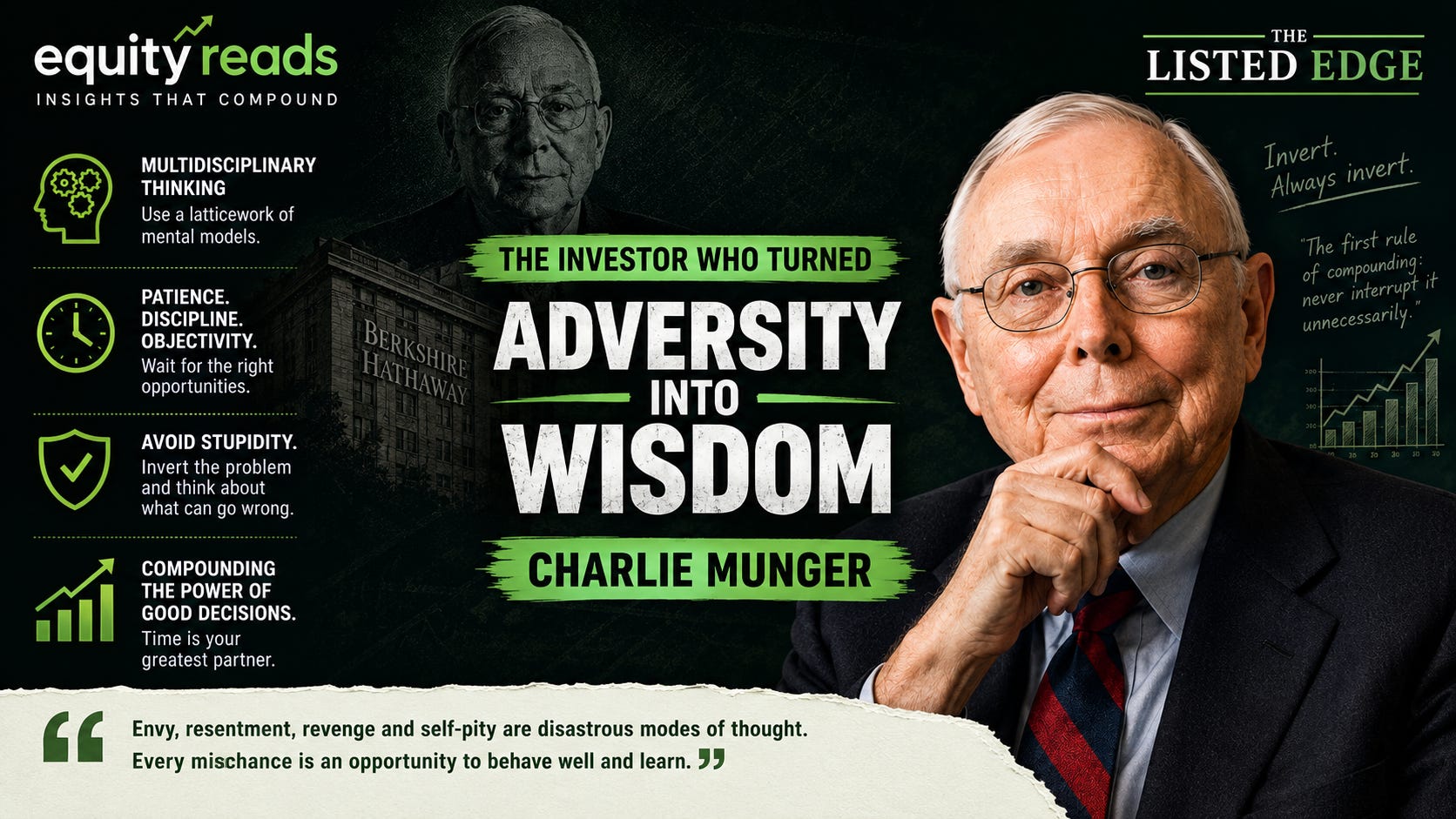
A Life Tested by Adversity
Charlie Munger’s life was marked by extraordinary adversity. After Harvard Law School came divorce, financial hardship and, most painfully, the loss of his nine-year-old son, Teddy, to leukemia in 1955.
At 52, a failed cataract operation left him blind in one eye. Yet Munger refused to let setbacks define him. His philosophy was simple: “Soldier through.” Accept what cannot be changed, endure the pain and keep moving forward.
From Lawyer to Investor
Munger began as a lawyer before moving into business and investing. His 1959 meeting with Warren Buffett became a turning point.
Munger encouraged Buffett to look beyond “How cheap is this business?” and ask the more important question: “How good is this business?”
That shift—from buying cheap businesses to owning wonderful businesses at fair prices—became central to Berkshire Hathaway’s transformation.
Buy Wonderful Businesses at Fair Prices
For Munger, quality mattered more than cheapness. Exceptional businesses can compound value through competitive advantages, high returns on capital, pricing power, capable management and consistent cash generation.
The lesson was simple: quality compounds.
Rather than chase cheap stocks, Munger and Buffett sought great businesses at fair prices—and then gave them time to compound.
Think like a Business Owner
Munger urged investors to see a stock as ownership in a business—not a price flashing on a screen.
Instead of asking, “Where will the share price be next month?”, ask:
“Would I be comfortable owning this business if the market closed for five years?”
That question shifts the focus from daily price movements to earnings, cash flow, competitive advantages, management and long-term economics.
Stay Inside Your Circle of Competence
Munger did not believe investors needed to understand every business. They needed to understand the limits of their own knowledge.
You do not have to participate in every opportunity. Missing an opportunity is not the mistake; investing in something you do not understand can be.
Build a Latticework of Mental Models
Munger believed great investing required multidisciplinary thinking. His “latticework of mental models” drew from psychology, economics, mathematics, history and science.
These different lenses helped him evaluate business economics, competition, management, technology, capital allocation and risk.
For Munger, investing was more than analysing numbers. It was about learning how to think.
Invert the Problem
Munger’s principle of inversion was simple:
Don’t just ask, “How can I make money?” Ask, “What could make me lose money?”
Before investing, identify what could damage the business, weaken its competitive advantage, hurt profits—or prove your thesis wrong.
Patience Is an Investment Advantage
Munger believed investors did not need to be constantly active. Exceptional opportunities are rare; the real skill is being prepared when they appear.
That requires patience, discipline and objectivity.
In a market flooded with prices, headlines and opinions, more information does not guarantee better decisions.
Concentrate When the Odds Are Strong
Munger believed concentration can make sense when understanding is deep and the odds are strongly in your favour.
But concentration should come from knowledge and conviction—not excitement or hope.
Understand first. Build conviction. Concentrate only when the odds favour you.
Management and Capital Allocation Matter
Munger looked beyond financial statements. A great business can still become a poor investment when management allocates capital badly.
He focused on integrity, incentives, capital allocation, competitive advantages and long-term economics.
For a long-term investor, management quality is not a side issue—it is part of the investment thesis.
The Berkshire Hathaway Transformation
Munger and Buffett formed one of the most influential partnerships in investment history.
Buffett brought exceptional capital-allocation skills, while Munger brought a broader framework for judging business quality and economics.
Together, they helped transform Berkshire Hathaway from a troubled textile company into a diversified collection of high-quality businesses and investments. Buffett later called Munger “the architect of Berkshire Hathaway.”
Their success was not built on constant trading. It was built on quality, intelligent capital allocation, patience and compounding—letting time do the heavy lifting.
The Greatest Investment: Himself
Munger’s greatest investment may not have been in a company, but in himself. Despite profound setbacks, he kept reading, learning, working and improving rather than surrendering to self-pity.
He understood that compounding extends beyond money: knowledge compounds, experience compounds, habits compound—and eventually, capital compounds.
Small, intelligent decisions repeated over time can produce extraordinary results.
What Munger Can Teach Today’s Investor
Munger’s lessons remain highly relevant in markets dominated by short-term thinking. Focus on the business, not just the stock price. A falling stock can represent an improving business, while a rising stock can hide deteriorating economics.
Avoid chasing every opportunity. Know what you do not know. Focus on avoiding permanent loss of capital, rather than fearing short-term volatility.
Remember: markets are driven not only by numbers, but also by human behaviour—fear, greed, overconfidence and incentives.
Think rationally. Keep learning. Let time work in your favour.
The Bottom Line
Munger’s philosophy can be distilled into four principles:
Quality over cheapness.
Patience over activity.
Understanding over speculation.
Learning over certainty.
His enduring lesson is simple:
Think independently. Avoid major mistakes. Buy quality. Let time compound good decisions.
Explore More from the Pages
Explore our research notes and investing frameworks and subscribe to Equity Reads for in-depth market insights. If you enjoy broader perspectives on markets, businesses, subscribe to TheListedEdge as well.
Disclaimer: This report is for educational and informational purposes only and does not constitute investment advice or a recommendation to buy or sell any security. Historical examples and investment philosophies do not guarantee future results. Readers should conduct their own research and consider their individual circumstances before making investment decisions.