


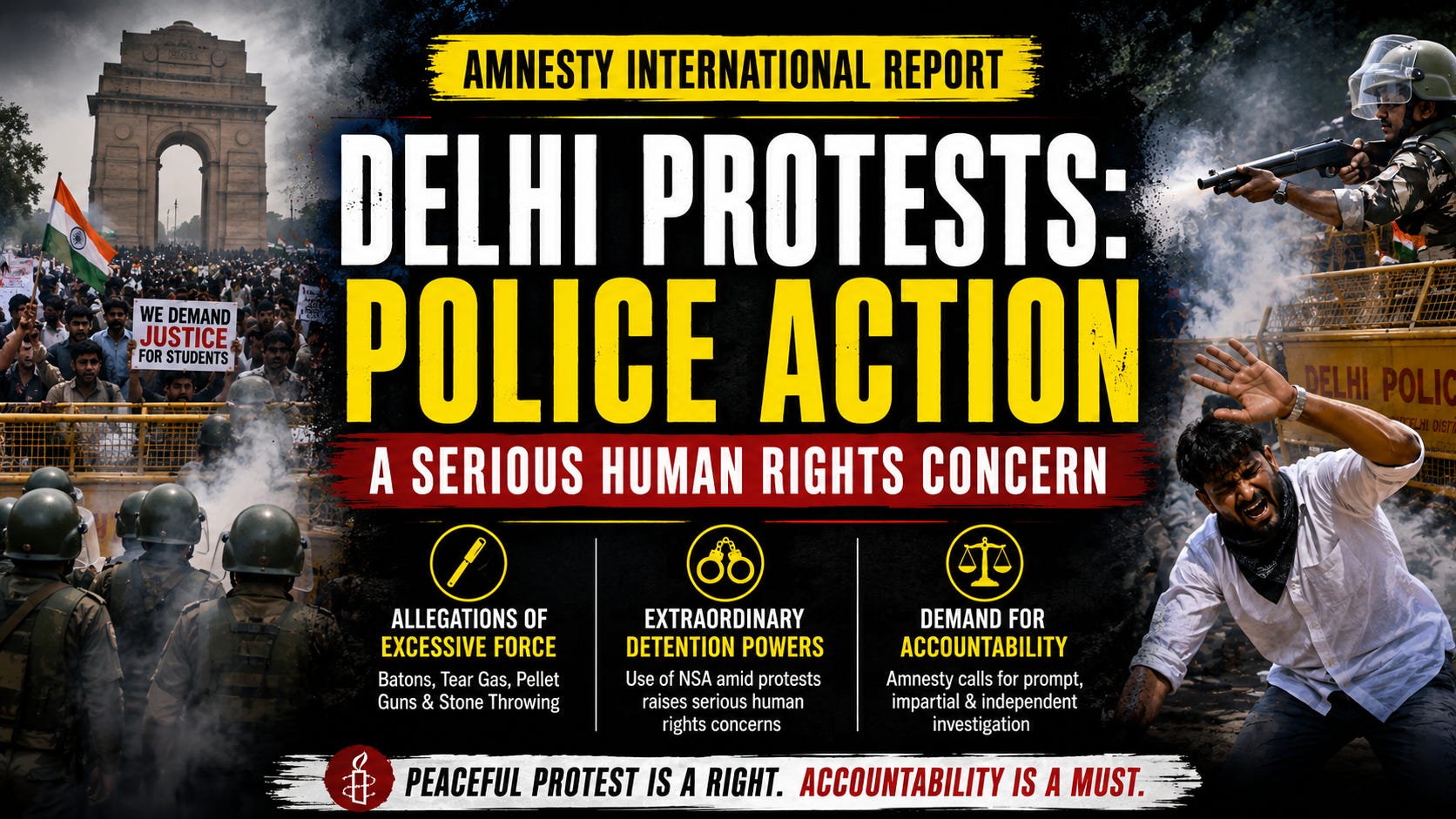
What began as concerns over the policing of protests in Delhi has developed into a much broader human-rights controversy. In three statements issued on 20 July, 24 July and 24 August 2026, Amnesty International and Amnesty International India raised progressively more serious concerns—from alleged excessive force and restrictions on peaceful assembly to the use of extraordinary detention powers and, most recently, allegations involving potentially unlawful and deadly force
20 July: The First Warning — Allegations of Excessive Force
In its 20 July statement, “India: Crackdown on peaceful protesters in New Delhi raises serious human rights concerns,” Amnesty International India Chair Aakar Patel said that images and reports from the Jantar Mantar protest raised concerns over the alleged use of unnecessary and excessive force against peaceful protesters.
Amnesty also pointed to barricades preventing protesters from reaching Parliament, along with the suspension of metro services and mobile internet.
Amnesty said that allegations included the use of batons and tear gas, as well as alleged stone-throwing by police personnel, and called for these allegations to be investigated promptly, independently and impartially.
At the heart of the protests were demands for accountability over alleged examination-paper leaks affecting millions of students. Protesters were also seeking compensation for families of students who allegedly died by suicide following examination-related distress. This background is important because the dispute was not simply about a confrontation with police—it began with demands for accountability in the education system.
24 July: From Crowd Control to Extraordinary Detention Powers
Four days later, the controversy moved beyond crowd-control tactics to the use of extraordinary detention powers. In its 24 July statement, “India: Invoking of extraordinary police powers amid Delhi protests an ‘affront to human rights’,” Amnesty criticised the invocation of powers under the National Security Act (NSA).
The organisation said that these powers could permit administrative detention without the normal procedural safeguards associated with criminal proceedings, raising concerns over access to information about the grounds of detention and legal representation.
Amnesty International India argued that using such powers during protests could undermine the rights to peaceful assembly, freedom of expression and protection from arbitrary detention. It urged the Delhi Police not to use administrative detention as a way of bypassing legal safeguards.
24 August: Amnesty’s Most Serious Allegations
The most serious concerns emerged on 24 August, when Amnesty International published a new investigation based on witness testimony and video and photographic evidence that it said had been verified by its Evidence Lab. Amnesty said it had verified 17 videos filmed in Delhi on 20 July and two videos filmed in Siwan, Bihar, on 24 July. According to Amnesty, the material showed the use of pellet-firing shotguns, tear-gas launchers and grenades, batons and electric-shock devices. The organisation further alleged that these weapons were used in ways that breached international standards and domestic policing guidelines.
Amnesty specifically reported evidence showing an RAF officer firing a shotgun into a crowd and said it verified videos showing protesters with injuries consistent with birdshot. It also documented what it described as repeated baton strikes against protesters, including a young boy, and alleged the use of an electric-shock baton against a peaceful protester.
Amnesty also said it had verified videos from Siwan showing a state police officer firing an AK-type assault rifle at protesters. It argued that the use of such firearms during an assembly should be restricted to situations where there is an imminent threat of death or serious injury and no less harmful alternative is available.
The Bigger Question: Who Will Be Held Accountable?
For Amnesty, the controversy does not end with the alleged use of force. The bigger question is what happened afterwards—and whether there will be meaningful accountability.
Its 24 August investigation states that, one month after the protests, no Delhi police officer had been held accountable, according to Amnesty. The organisation called for a prompt, impartial and effective investigation into the reported use of firearms, birdshot ammunition, tear gas, lathis and electric-shock weapons, with the findings made public.
The organisation also noted that the Delhi Police had publicly denied disproportionate use of force and described its handling of the protest as professional. Amnesty said the evidence it gathered contradicted that account.
Three Statements, One Escalating Concern
Read chronologically, the three Amnesty statements show a clear escalation in the organisation’s concerns:
20 July: Concerns over alleged excessive and disproportionate police force.
24 July: Opposition to the use of extraordinary detention powers during protests.
24 August: More serious allegations involving firearms, birdshot, tear gas, batons
and electric-shock devices, alongside concerns over accountability.
Important: The allegations and findings described in this report are those reported by Amnesty International. They should not be read as a judicial determination of criminal liability against individual police officers. Amnesty itself is calling for an independent investigation to establish the facts and responsibility.
Conclusion
The central question is not whether the authorities have a duty to maintain public order—they do. The real question is whether the methods used to maintain that order were lawful, necessary and proportionate.
Amnesty’s reports do not settle that question; they call for it to be independently investigated. That distinction is important. But so too is the principle at stake: maintaining public order cannot come at the cost of accountability.
The right to peaceful protest and the responsibility to maintain public order must ultimately coexist within the framework of law.
The 24 August Amnesty investigation is also available on Amnesty International’s official website, alongside the earlier 20 July and 24 July statements. (Amnesty International)
Few days back I asked ChatGPT why Ammnesty, Western media remain total silent on cruelty on its citizen by Iran, China, Cuba, N Korea , Pakistan, Bangladesh, Lebnon, Syria, African countries but only get red when even a minor police action like lathi charge happen. Answer was shameful to read. Better writer ask this from ChatGPT . I can not write here lengthy explanation given by ChatGPT. Further violence started by protesters who said it was a peaceful demonstration. See again those violence videos bt protesters. Goondas involved in Delhi riots were there . Will not write name but it is available on social media. How then policemen injured ,died if it was peaceful.