


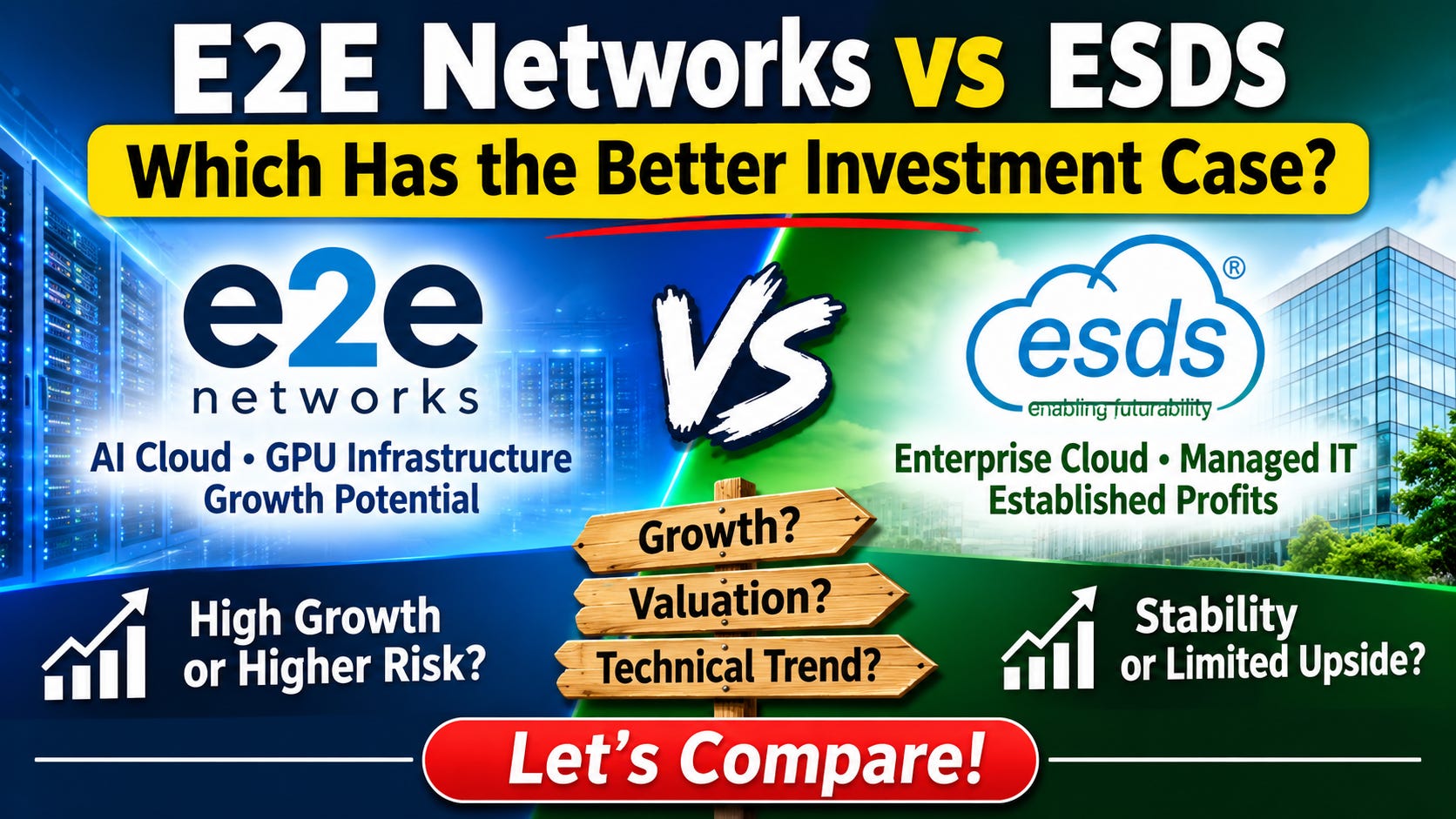
Growth is not the same as shareholder value
Artificial intelligence is accelerating demand for GPU computing, cloud infrastructure and secure data centres. This creates a sizeable opportunity for Indian digital infrastructure providers—but industry growth alone does not guarantee attractive shareholder returns.
E2E Networks and ESDS Software Solution offer exposure to this opportunity through different business models. E2E is pursuing an AI-computing-led strategy, while ESDS combines enterprise cloud, managed services, data centres and sovereign technology.
The investment question is not simply which company is growing faster. It is which can convert demand into durable earnings, healthy cash flows and adequate returns on invested capital—without asking investors to pay too much upfront.
Business models: Two routes into the AI economy
E2E Networks: A focused bet on AI computing
E2E has repositioned its cloud business around AI infrastructure, offering GPU-as-a-Service, high-performance computing and AI/ML solutions. Two recent initiatives highlight its ambition:
On 26 October 2026, the company announced a proposed 5.4 MW Blackwell expansion, which would increase planned AI infrastructure capacity from 9.2 MW to approximately 14.6 MW.
On 2 November 2026, it launched Blaze, a pay-per-token inference service for open AI models.
These initiatives could broaden demand for E2E’s computing services. Their financial contribution, however, will depend on customer acquisition, utilisation, pricing and ability to recover substantial infrastructure costs. Announced capacity should not be confused with operational, revenue-generating capacity.
ESDS: A broader enterprise technology platform
ESDS operates across cloud computing, managed services, SaaS, colocation, cybersecurity and disaster recovery. Its five Tier-III data centres serve government, BFSI and enterprise customers.
Its SWARAJ ecosystem includes more than 52 integrated cloud, AI, cybersecurity and managed services. Products such as Nandi, Hansa and Sethu extend its offerings into security and DevSecOps. The opportunity lies in cross-selling these services and increasing recurring enterprise revenue; the scale of their commercial contribution still needs to be demonstrated.
The distinction is important: E2E offers more direct exposure to AI-computing growth, while ESDS has a wider enterprise infrastructure and services base.
Financial performance: Revenue growth versus earnings quality
E2E Networks: Exceptional revenue acceleration
E2E reported Q2 FY27 revenue of ₹223.76 crore, compared with ₹43.80 crore a year earlier—growth of approximately 411%. Operating profit before depreciation and amortisation was ₹171.46 crore, representing a margin of about 76.6%.
However, depreciation of ₹73.97 crore and finance costs of ₹10.30 crore reduced the benefit reaching shareholders. Net profit was ₹72.70 crore, against a loss of ₹13.46 crore in Q2 FY26. For H1 FY27, revenue reached ₹380.52 crore and net profit ₹116.59 crore.
The improvement is substantial, but the cost base matters. FY26 depreciation of ₹169.23 crore against revenue of ₹245.58 crore illustrates the capital intensity of GPU infrastructure. Investors should assess whether current growth can translate into durable post-depreciation earnings and cash generation.
ESDS: Profitable growth, with margin pressure
ESDS reported Q2 revenue of ₹138.34 crore, up 47.5%. EBITDA increased 18.3% to ₹57.76 crore, while net profit rose 40.7% to ₹31.09 crore.
For H1, revenue grew 25% to ₹272 crore, but EBITDA increased by only 12.3% to ₹113.75 crore. The EBITDA margin consequently declined from 46.4% to 41.8%. The company attributed ₹2.34 crore of Q2 expenses to IPO-related marketing and advertising. Existing customers contributed 86.7% of quarterly revenue, indicating encouraging customer continuity.
E2E currently leads on revenue momentum, but depreciation and financing costs are material. ESDS offers more established profitability, although its margin compression deserves attention. The quality and sustainability of earnings matter more than headline growth alone.
Cash flow, debt and capital allocation
E2E: Expansion requires substantial capital
During H1 FY27, E2E reported operating cash flow of approximately ₹396.49 crore against property, plant and equipment purchases of ₹419.60 crore. This leaves a shortfall of about ₹23.11 crore before other investing expenditure.
Borrowings increased from ₹159 crore in March 2026 to approximately ₹450 crore in September. Cash and cash equivalents stood at ₹599 crore, with additional bank balances of ₹135 crore. This liquidity provides some comfort, but operating cash flow includes a substantial increase in other non-current liabilities. Investors should therefore examine the underlying sources and repeatability of cash generation.
The central test is whether higher GPU utilisation and recurring customer contracts can generate returns sufficient to justify the expansion.
ESDS: Strong liquidity after the IPO
ESDS generated H1 operating cash flow of approximately ₹108.62 crore against PPE purchases of ₹55.03 crore. However, total investing cash outflow was approximately ₹389.92 crore, including ₹334.86 crore under other investing activities—an item that merits closer examination.
The fresh issue raised approximately ₹720 crore. At September-end, cash and cash equivalents stood at about ₹1,637 crore, with additional bank balances of ₹342 crore. Borrowings were approximately ₹48 crore, excluding lease liabilities. Around 80% of the IPO proceeds were earmarked for cloud-computing and data-centre equipment.
ESDS has the stronger liquidity position and lower borrowings. E2E faces greater infrastructure and financing demands. For both companies, the decisive measure will be the incremental return earned on capital expenditure—not simply the amount invested.
Valuation: Is the growth already priced in?
As of 6 November 2026, E2E traded at approximately ₹486.60, with a market capitalisation of around ₹10,005 crore. ESDS traded near ₹1,115.50, with a market capitalisation of approximately ₹13,060 crore.
Neither stock appears to be an obvious bargain solely because its share price has corrected. E2E’s FY26 loss makes historical price-to-earnings comparisons less useful; its valuation increasingly rests on sustaining the recent earnings acceleration and generating adequate returns from its expanding GPU infrastructure.
ESDS has a stronger post-IPO balance sheet, but its valuation also incorporates expectations of future growth. Those expectations need to be supported by margin stabilisation or recovery, earnings expansion and productive deployment of IPO proceeds.
The key point: a sharp correction does not automatically make a stock inexpensive. Future earnings and returns on capital must justify the price investors are being asked to pay.
Technical outlook: Correction or genuine reversal?
Both stocks have fallen substantially from their recent highs. That may bring them onto investors’ watchlists, but a falling share price is not, by itself, evidence of a buying opportunity.

E2E Networks
Price: ₹486.60
52-week high: ₹769
Decline from 52-week high: approximately 36.7%
RSI (14): approximately 34.5
E2E is below its 20-day and 50-day moving averages but remains above its 200-day average. This points to short-term weakness, without yet confirming a complete long-term trend reversal.

ESDS Software Solution
Price: ₹1,115.50
52-week high: ₹1,864.35
Decline from 52-week high: approximately 40.2%
RSI (14): approximately 37.5–40.7
ESDS continues to show negative MACD momentum and trades below its short-, medium- and long-term moving averages. A meaningful recovery would require stronger volumes, improving relative strength and sustained accumulation on the weekly chart.
Which stock offers the better investment proposition?
Medium term: ESDS has a marginal edge
ESDS’s broader enterprise business, established profitability and stronger liquidity provide comparatively greater financial comfort. However, margin compression, a premium valuation and weak technical momentum argue against treating it as an immediate buying opportunity. E2E offers greater growth potential, but carries higher execution, depreciation and financing risks.
Long term: ESDS remains the more balanced proposition
ESDS’s cloud, managed-services, data-centre and software businesses provide several potential growth avenues, while its liquidity offers flexibility for expansion. E2E could deliver stronger growth if AI-computing demand accelerates and its GPU infrastructure achieves attractive utilisation.
The choice is therefore not between a good company and a bad one. ESDS is the comparatively balanced infrastructure proposition; E2E is the more aggressive AI-growth opportunity.
What would change the investment view?
For E2E Networks
Sustained revenue and profit growth over the next two or three quarters.
Improving GPU utilisation and a growing base of recurring customer contracts.
Positive cash generation after infrastructure expenditure.
Borrowings remaining manageable relative to operating cash generation.
A confirmed price recovery above the 50-day and, subsequently, the 200-day moving averages.
For ESDS
Revenue and profit growth accompanied by margin stabilisation or recovery.
Consistent operating cash generation.
Evidence that new data-centre investments are earning attractive returns.
A meaningful commercial contribution from SWARAJ and AI-related products.
Productive deployment of IPO proceeds.
A more reasonable valuation, or earnings growth sufficient to justify the premium.
A confirmed weekly-chart reversal.
These developments would strengthen the underlying investment case, rather than merely improve short-term market sentiment.
Final verdict: Growth versus financial strength
E2E Networks and ESDS offer two distinct ways to participate in India’s expanding AI and cloud infrastructure market. E2E has stronger recent revenue momentum, and its GPU expansion and Blaze inference platform offer significant potential. But it must show that infrastructure investment can produce sustainable earnings and positive cash flow after capital expenditure.
ESDS has a broader enterprise business, established profitability and stronger liquidity following its IPO. Its challenges are different: margin compression, capital allocation and a valuation that already reflects expectations of future growth.
My preference remains conditional:
Medium term: ESDS, marginally, because of its comparatively stronger financial profile—but only after technical confirmation.
Long term: ESDS for a more balanced investment proposition.
Aggressive growth: E2E for investors willing to accept higher execution, capital-intensity and valuation risks.
Reversal strategy: Monitor both; do not rush into either simply because prices have corrected sharply.
The global AI sell-off on 5 November 2026—during which the Nasdaq Composite fell 5.5% and the semiconductor index declined approximately 12%—is a reminder that enthusiasm for AI infrastructure does not guarantee attractive returns on invested capital BUT may offer the better Risk Reward to enter.
At the stated valuations and technical positions, neither stock can be called a clear winner. E2E must demonstrate that its GPU investments can earn attractive returns; ESDS must show that expansion can translate into sustainable margins.
The investment principle is straightforward: growth creates the opportunity, financial performance establishes its quality, valuation determines what investors pay, and price action helps identify when to participate. I would rather looking for a fundamentally promising business to form a convincing base than buy simply because its share price has fallen.
Disclaimer
This report is intended exclusively for informational and educational purposes and is based on publicly available information stated to be current. Financial figures, valuations and technical observations should be independently checked against the latest company disclosures and stock-exchange filings.
Equity investments involve market, business, liquidity and valuation risks. Past performance does not guarantee future returns. Readers should conduct their own research and consult a SEBI-registered investment adviser before making investment decisions.
This report does not constitute investment advice or a solicitation or recommendation to buy, sell or hold any security. Equity Reads and the writer accept no responsibility for investment decisions or financial losses arising from the use of this material.