


Fractal is becoming a more credible enterprise-AI story, but still needs confirmation. Q1 FY27 showed a compelling combination of revenue, EBITDA, net-profit growth and improving customer economics. At the same time, the chart remains in a base-building phase.
That creates the central investment question: can stronger fundamentals become the catalyst for the next stock-market re-rating?
The answer is not yet obvious — and that is what makes Fractal interesting to watch.
From Analytics to Enterprise AI
Fractal combines AI, analytics, engineering and design for large global enterprises across CPG & Retail, Healthcare, BFSI, Insurance and TMT. The strategic shift is more important than the labels: the company is moving beyond a traditional analytics-services model toward enterprise AI platforms, agentic workflows and industry-specific products, led by Cogentiq.
If those products scale, the economics could become more attractive than a purely services-led model: greater scalability, potentially better margins and more recurring revenue. The key word is potential. The investment thesis now depends increasingly on whether Fractal can convert AI capability into durable commercial scale.
Q1 FY27: The Numbers Are Starting to Tell a Better Story
The headline numbers were strong:
· Revenue: +20% YoY
· EBITDA: +35% YoY
· Net profit: +92% YoY
· EPS: +78% YoY
Adjusted EBITDA margin was around 17%, while net margin reached roughly 8%. The more important signal is operating leverage: profitability is expanding much faster than revenue. That suggests the business is not merely growing; it is beginning to extract more earnings from that growth.
Growth Is Broad-Based — But TMT Is the Clear Watchpoint
· Healthcare & Life Sciences: +69%
· BFSI: +36%
· CPG & Retail: +19%
· Others: +63%
· TMT: -22%
The breadth of growth is encouraging, particularly in Healthcare & Life Sciences and BFSI. TMT, however, remains the obvious weak spot. That makes TMT recovery one of the most important variables to monitor in the next few quarters.
A sustained recovery in TMT would not only improve growth optics; it could also increase confidence that Fractal’s expansion is broad enough to withstand weakness in any one vertical.
AI Investment: Building the Next Leg of Growth
Fractal is investing for the next phase rather than simply harvesting current demand. R&D spending rose 31% YoY to ₹61 crore in Q1 FY27, with investment across Cogentiq, Asper and Analytics Vidhya.
Cogentiq sits at the Centre of the strategy. It is positioned as an agentic AI platform designed to move enterprises from AI experimentation toward real-world workflows across pricing, supply chains, customer service and operations.
This is where the long-term thesis becomes more interesting. If these platforms achieve meaningful scale, Fractal could gradually shift part of its revenue mix toward more scalable and potentially higher-margin, recurring streams.
Healthcare and BFSI: Two Important Growth Engines
Healthcare & Life Sciences grew 69% YoY, making it one of Fractal’s fastest-growing verticals. The company is also developing Vaidya/Cogentiq Health and has secured healthcare AI and data-modernisation opportunities.
BFSI grew 36% YoY, supported by demand for AI across fraud, underwriting, risk, claims, pricing, compliance and customer experience.
These verticals share a useful structural advantage: large datasets, complex workflows and high governance requirements. That combination fits Fractal’s domain expertise and enterprise-AI positioning particularly well.
Partnerships: The Opportunity Is Above the Model Layer
Fractal’s Anthropic partnership and relationships across the broader AI ecosystem strengthen its enterprise proposition. The company does not need to win the foundation-model race.
Its opportunity is to become the implementation and transformation layer connecting frontier AI models with large enterprises. That positioning could become increasingly valuable as enterprises move from AI pilots to production workflows.
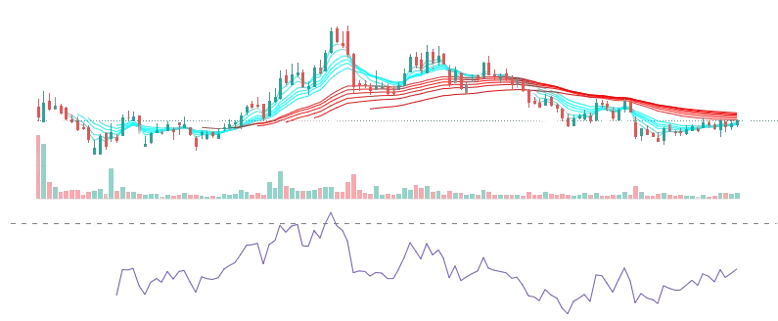
The Chart: A Base Is Taking Shape — Not a Breakout Yet
The daily chart suggests that Fractal has moved beyond the sharpest phase of its correction and is attempting to build a base. A sustained move above the GMMA, accompanied by stronger volume and continued momentum, would make the bullish setup considerably more convincing.
Short-Term Outlook: Cautiously Positive
Fractal is becoming interesting for positional investors because the technical picture is improving while the fundamental picture is already constructive.
· RSI has recovered above 55.
· A potential higher-low structure is emerging.
· Fundamentals are improving faster than the chart.
· Confirmation still requires a decisive GMMA breakout with stronger volume.
Short-term view: early recovery — watch for confirmation.
Medium-Term Outlook: Positive, If Earnings Momentum Holds
The medium-term setup is attractive because revenue growth, margin expansion and AI investment are moving in the same direction. Q1 FY27 was particularly encouraging because EBITDA and net profit grew materially faster than revenue.
Over the next few quarters, the most useful checkpoints are:
· Revenue growth sustaining in the high-teens/20% range.
· EBITDA margins remaining stable or improving.
· Evidence that Cogentiq, Asper and other AI products are being monetised.
· Recovery in TMT while Healthcare and BFSI continue to deliver.
Long-Term Outlook: The Bigger Bet Is Enterprise AI Adoption
The long-term opportunity is not simply the growth of AI; it is the adoption of AI inside large enterprises. Fractal is positioning across AI implementation, governance, industry-specific solutions, agentic workflows and enterprise transformation.
Its analytics heritage, enterprise relationships and AI-product portfolio provide a foundation for that transition. If succeeds, Fractal could develop a higher-quality and more scalable earnings profile.
What Could Go Wrong?
· Valuation: strong growth must justify the premium investors are willing to pay.
· TMT: prolonged weakness could constrain overall growth.
· Competition: enterprise AI is rapidly evolving and intensely competitive.
· Product monetisation: R&D investment must translate into meaningful revenue.
· Expectations: high expectations can amplify stock volatility when execution disappoints.
Bottom Line: Fundamentals Are Leading. The Chart Needs to Catch Up.
Fractal’s Q1 FY27 numbers strengthen the investment case: 20% revenue growth, 35% EBITDA growth, 92% profit growth and 117% NRR. More importantly, the company is building exposure to the next phase of enterprise AI through Cogentiq, healthcare AI and industry-specific solutions.
The biggest long-term question is whether AI products can scale into meaningful recurring revenue. Technically, the stock is improving — but the breakout still needs confirmation.
My view: fundamentally attractive, technically improving, but waiting for a confirmed breakout. For investors willing to wait for evidence rather than anticipate it, Fractal looks like a potential AI re-rating story in the making.
Disclaimer
This Substack note is based on publicly available company information, recent financial disclosures and the daily chart. It represents an analytical view, not investment advice or a recommendation to buy or sell the stock. AI-related businesses can be highly competitive and valuation-sensitive. Investors should independently verify the latest financial results, valuation, shareholding, corporate announcements and market conditions before taking any investment decision. Past performance does not guarantee future returns.