


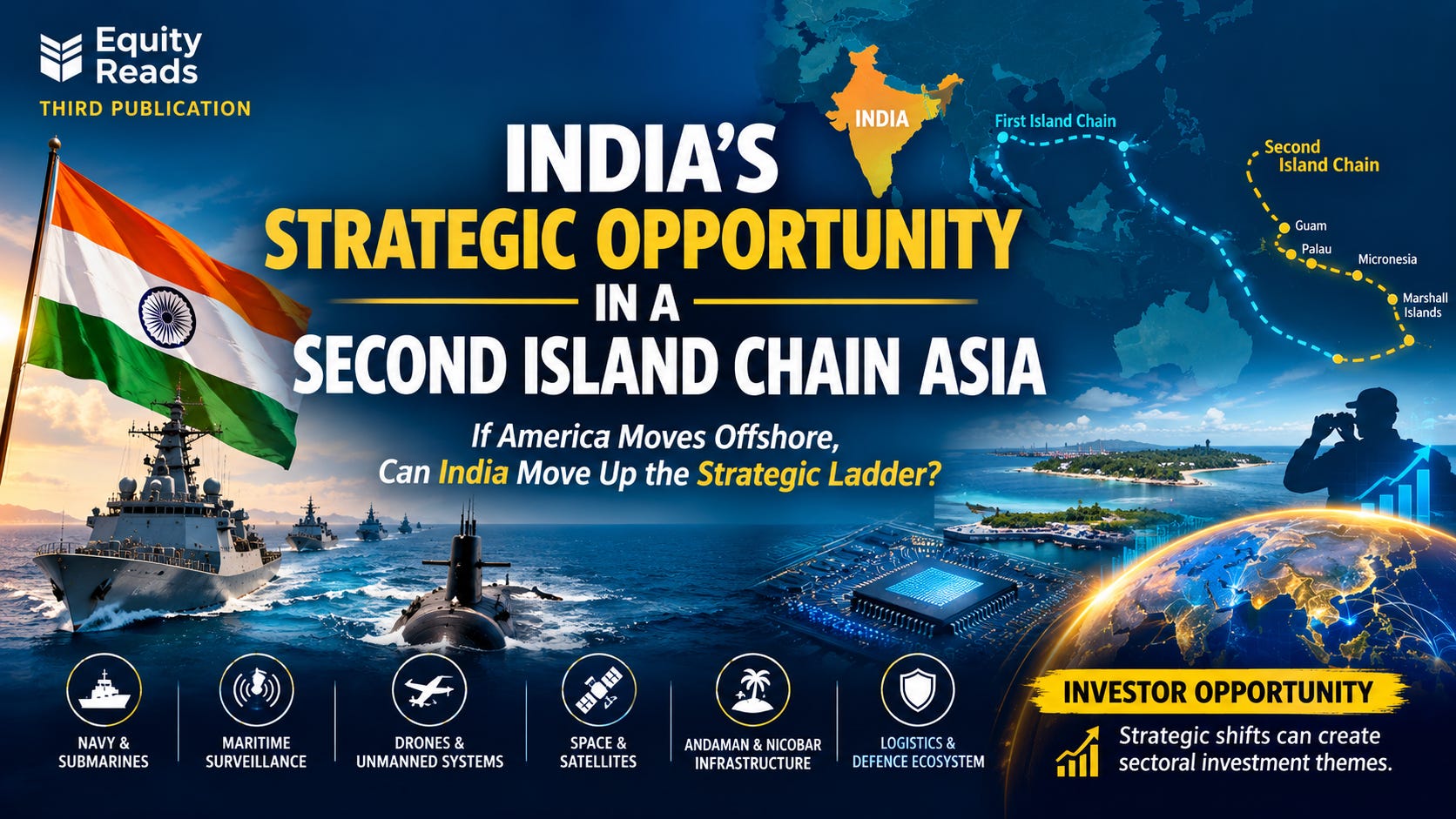
A Geopolitical Shift with an Investment Dimension
Jennifer Kavanagh’s “Second Island Chain” concept argues for greater reliance on regional partners rather than maintaining a heavy concentration of US military assets close to China. If such a direction gains importance, countries like India could be expected to shoulder a larger share of regional security responsibilities.
For India, that could mean more than higher defence spending. It could accelerate the development of an entire strategic-industrial ecosystem.
Where Could the Money Flow?
A larger maritime and Indo-Pacific role could increase demand for:
Naval and submarine capabilities
Maritime surveillance and sensors
Drones and unmanned systems
Space-based surveillance
Defence electronics and communications
Anti-submarine warfare systems
Strategic logistics and infrastructure
Specialised engineering and materials
The Andaman & Nicobar Islands could become particularly important because of their strategic location along critical maritime routes.
But the bigger opportunity may not necessarily be the headline defence platform.
A warship, submarine or surveillance network requires hundreds of components from electronics and sensors to software, communications, propulsion and specialised engineering. That means the supply chain could ultimately offer a broader investment opportunity than the final platform itself.
Taiwan Adds Another Layer
Any serious Taiwan crisis could disrupt semiconductors, shipping and global supply chains. For India, that creates risk—but potentially also an opportunity.
Global manufacturers could accelerate diversification of electronics manufacturing, testing, components and supply chains away from concentrated East Asian locations.
India could potentially benefit across electronics and EMS, telecom equipment, power electronics, industrial automation, semiconductor-related materials, precision engineering, logistics and warehousing.
The Investor’s Question
This is where investors need to be careful. A powerful theme does not automatically make every stock within that theme attractive.
The real questions are:
Does the company have difficult-to-replicate technology?
Is its order pipeline sustainable?
Can it execute?
Does revenue turn into cash?
Can it expand without destroying returns?
And has the market already priced in the opportunity?
The Bigger Picture
The Second Island Chain may never become formal US policy. Yet the strategic direction behind the idea is worth watching.
If India gradually assumes greater responsibility in the Indo-Pacific, geopolitics could become an increasingly important industrial-policy driver—supporting domestic defence manufacturing, technology development, strategic infrastructure and supply-chain localisation.
This is unlikely to be a one-quarter story.
It could become a multi-year structural investment theme spanning defence, maritime systems, space, electronics, drones, communications and strategic infrastructure.
The opportunity, therefore, may not be simply “defence stocks.” It may be identifying the companies capable of converting India’s emerging strategic requirements into sustainable revenue, cash flow and shareholder value.
Disclaimer
This is a thematic and educational analysis, not a recommendation to buy or sell any security. The Second Island Chain is a strategic concept, not established US policy, and geopolitical developments can change rapidly. Investors should independently evaluate fundamentals, valuations, cash flows, balance sheets, execution and competitive advantages before making investment decisions. Not investment advice.