


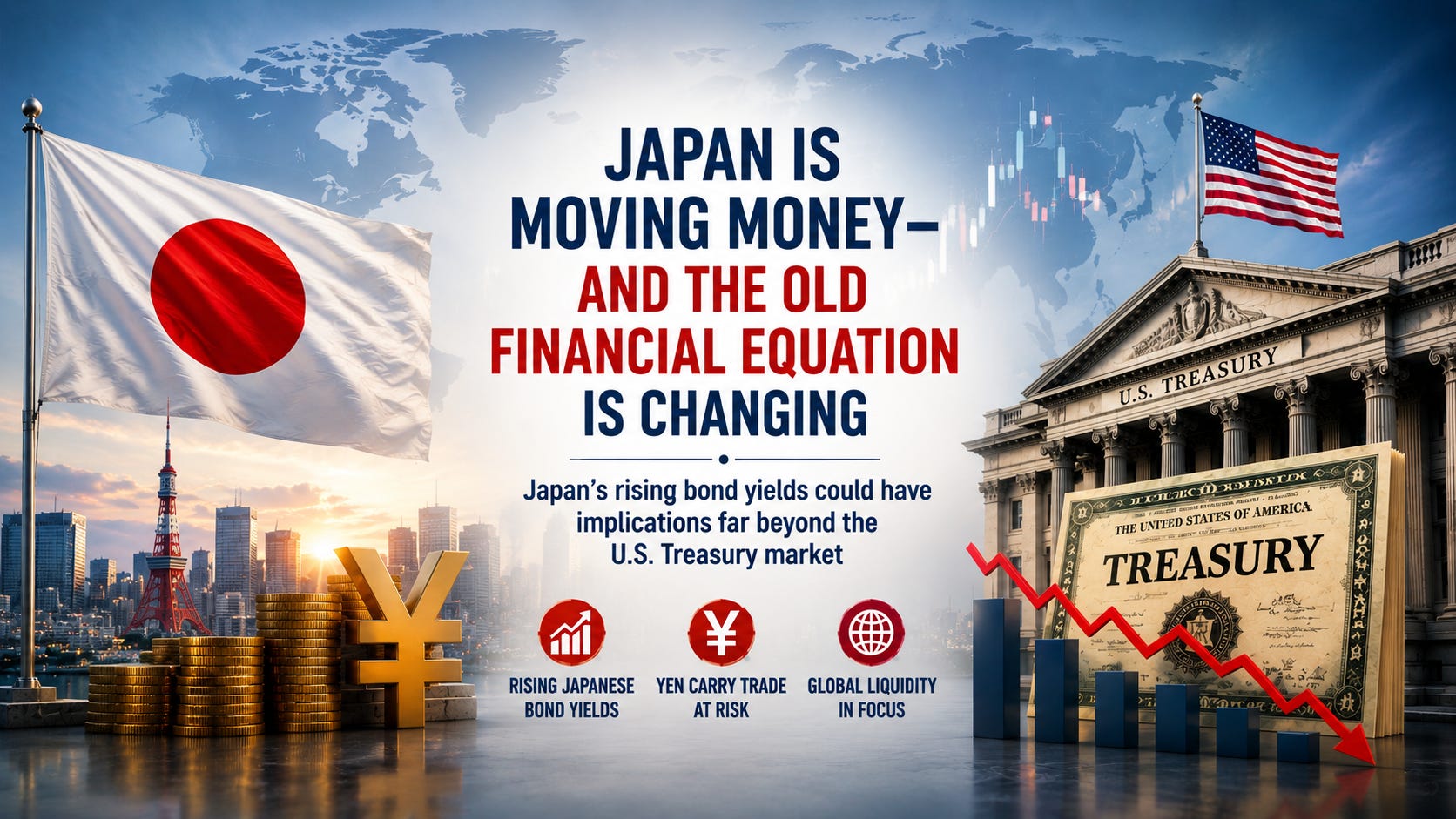
Japan remains the largest foreign holder of U.S. Treasuries, with about $1.117 trillion held in June 2026—down from its $1.325 trillion peak in November 2021. But the real story is not that Japan is “dumping” U.S. debt. It is that the economic equation that once made overseas investment almost irresistible is gradually changing.
For decades, the equation was straightforward: very low Japanese yields pushed Japanese savings overseas, with U.S. Treasuries being one of the biggest beneficiaries. Japanese investors were willing to accept currency risk because the yield advantage and liquidity of U.S. assets made the trade attractive.
But that equation is changing. With the 10-year Japanese Government Bond yield around 2.9%, Japanese domestic bonds are once again offering meaningful returns. For Japanese institutions, the question is increasingly simple: why take dollar and currency risk when attractive yields are becoming available at home?
This matters because weaker Japanese demand for Treasuries comes at a time when U.S. debt issuance is enormous. The concern is therefore not that Japan suddenly sells $1 trillion of Treasuries. The bigger issue is marginal demand. If Japanese investors buy fewer Treasuries while U.S. debt issuance remains enormous, Treasury prices could face pressure and yields could remain elevated—raising borrowing costs and potentially tightening global financial conditions.
There is another important channel—the yen carry trade, which may actually pose the bigger risk for equity markets. As Japanese rates rise and the yen strengthens, borrowing cheaply in yen to invest in overseas assets becomes less attractive. An unwinding of that trade can mean selling overseas assets, buying yen and repaying yen borrowing—effectively removing liquidity from global markets. The sharp market reaction during the August 2024 carry-trade unwinds showed how quickly this mechanism can affect global equities.
There is also a geopolitical dimension to this financial story. The U.S. is having to balance military resources between the Middle East and the Indo-Pacific, while Japan is simultaneously strengthening its own defence capabilities. This raises a broader question: is Japan gradually moving toward greater financial and strategic self-reliance?
The financial relationship—Japan financing America through Treasury purchases—and the security relationship—America providing strategic protection to Japan—are both evolving.
My view: This is a slow-moving structural shift, not an overnight crisis. I would therefore avoid reading every decline in Japanese Treasury holdings as a major exit. Instead, the trend needs to be watched through three indicators: JGB yields, USD/JPY and Japan’s monthly Treasury holdings.
The next important test will come with the July Treasury data, due on September 16. If Japanese holdings stabilise, the recent decline may prove to be largely portfolio adjustment or reserve management. But if the decline accelerates, it will provide stronger evidence that a more structural reallocation of Japanese capital is underway.
For Indian investors, this story deserves attention because the impact need not stop at U.S. bonds. A sustained Japanese repatriation could influence global liquidity, the dollar, gold, FII flows and emerging markets—including India. The key question is whether any reduction in Japanese overseas investment remains gradual or develops into a broader global liquidity event.
Disclaimer: This note is for educational and informational purposes only and should not be construed as investment advice, a recommendation to buy or sell any security, or a prediction of future market movements. Investors should conduct their own research and consult a qualified financial adviser before making investment decisions.