



A promising theme, but what lies ahead for the fund?
By the time an investment theme attracts widespread attention, and Mutual Funds start any sector specific fund, its leading stocks may have already rallied significantly. A market correction, however, can offer a second opportunity—provided the underlying growth story remains intact.
Further, India’s defence sector continues to benefit from rising government spending, domestic manufacturing, import substitution, modernisation and export opportunities. Although defence stocks have corrected after substantial rallies, the long-term industry drivers remain relevant.
This report examines the Motilal Oswal Nifty India Defence Index Fund, focusing on its portfolio, valuations and medium-to-long-term return potential.
The real question is not whether India’s defence industry has a promising future, but whether its underlying companies can deliver enough earnings and cash-flow growth to justify their valuations—and whether the correction has made the fund attractive at current levels.
Understanding the Fund: What Are Investors Buying?
The Motilal Oswal Nifty India Defence Index Fund is a passive; open-ended equity fund launched on 3 July 2024. It tracks the Nifty India Defence TRI rather than relying on active stock selection by a fund manager.
Investors essentially gain exposure to listed Indian defence companies through a single fund.
Key details:
Benchmark: Nifty India Defence TRI
Direct expense ratio: Approximately 0.50% (September 2026 disclosure)
Exit load: 1% within 15 days; nil thereafter
Risk: Very High
The fund’s performance will depend on its index constituents, their earnings growth and valuations.
The key takeaway: You are not buying a fund manager’s best defence-stock picks but the broader defence index, along with its opportunities and risks.
Portfolio Analysis: Where Is Your Money Actually Invested?
As of October 2026, the fund held 22 stocks, with its top 10 accounting for approximately 85.84% of the portfolio.
Top 10 Holdings:
Hindustan Aeronautics (HAL) – 21.80%
Bharat Electronics (BEL) – 20.26%
Bharat Forge – 12.64%
Solar Industries – 12.11%
MTAR Technologies – 3.94%
Mazagon Dock – 3.43%
Astra Microwave – 3.39%
Data Patterns – 3.05%
Cochin Shipyard – 2.85%
Bharat Dynamics – 2.37%
Other holdings: BEML, Zen Technologies, Garden Reach Shipbuilders, Paras Defence, Apollo Micro Systems, Dynamatic Technologies, Mishra Dhatu Nigam and Centum Electronics, among others. The portfolio covers defence PSUs and private manufacturers across aerospace, electronics, ammunition and specialised engineering.
What stands out?
HAL, BEL, Bharat Forge and Solar Industries alone account for approximately 66.8% of the portfolio.
The takeaway: Despite holding 22 stocks, this remains a concentrated thematic bet. The performance of a handful of companies could largely determine the fund’s returns.
Historical Performance: What Has the Fund Delivered?
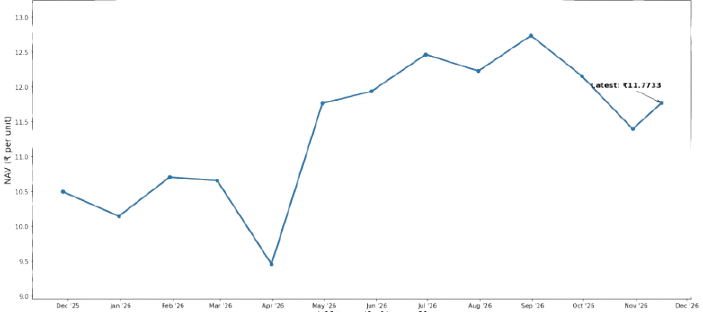
Launched in July 2024, the fund has a limited track record, with no three- or five-year performance history yet.
Its NAV fell from approximately ₹13.11 in September 2026 to ₹11.90 in November, a decline of around 9%.
The key takeaway: Past defence-sector rallies should not define future return expectations. Going forward, sustainable earnings growth—not valuation re-rating—will determine the fund’s performance.
India’s Defence Opportunity: The Structural Growth Story
India’s defence growth story remains supported by rising government spending, domestic manufacturing and exports.
The Union Budget 2026–27 allocated approximately ₹7.85 lakh crore to defence, up 15.19% over the previous year’s Budget Estimates, with 75% of capital acquisition spending reserved for domestic industry.
The opportunity extends beyond government procurement, with rising defence production, exports, private-sector participation and investment in indigenous technologies.
Key growth drivers include modernisation, import substitution, defence exports, electronics, missiles, drones and advanced manufacturing.
The key takeaway: India’s defence opportunity is structural, but rising government spending must ultimately translate into sustainable earnings and cash-flow growth for the companies in the fund.
Geopolitical Tensions: Another Tailwind for Defence Demand
Rising geopolitical tensions, including the conflicts involving Russia and Ukraine and the escalating US–Iran–Israel tensions, are reinforcing global demand for defence equipment. Countries are increasing military preparedness, replenishing ammunition stockpiles and investing in modern warfare capabilities.
This creates opportunities for manufacturers of ammunition, artillery shells, missiles, radars, sensors, drones, electronic warfare systems and other defence equipment. For Indian manufacturers, this could translate into stronger domestic procurement, export opportunities and sustained demand.
India could benefit from this changing global defence environment. European demand for Indian ammunition and artillery shells is already rising, driven by the need to replenish stocks following the Russia–Ukraine war.
The broader opportunity extends to defence electronics, radars, sensors, missiles and other specialised equipment. However, export opportunities will depend on India’s ability to deliver quality products at scale and meet international requirements.
The takeaway: Modern conflicts are not just increasing demand for sophisticated weapons; they are creating a long-term need to replenish what wars consume. That could become an additional growth engine for India’s defence manufacturers.
What Could Drive Future Performance?
The fund’s next growth phase will depend on whether its underlying companies can convert industry opportunities into financial performance.
Key drivers include:
Order-book execution: Converting orders into revenue and profits.
Margins: Improving manufacturing efficiency and operating leverage.
Exports: Expanding international business.
Technology: Growing demand for drones, radar, electronics and precision weapons.
Cash flows: Strong operating cash flow, working-capital management and returns on capital.
The key takeaway: Large order books make headlines, but sustainable profits and cash flows create shareholder wealth.
Has the Correction Created an Opportunity?
As of 16 November 2026, the Nifty India Defence Index traded at a P/E of 54.69x and P/B of 10.52x, still above its historical median P/E of approximately 47.69x.
The correction has improved entry levels, but valuations remain demanding. Future returns will depend on whether earnings growth justifies these multiples.
The key takeaway: A lower NAV does not necessarily mean a cheaper fund. The opportunity exists, but the margin of safety remains limited.
Key Risks to Watch
Major risks include:
Valuation: Expensive stocks may deliver weak returns.
Concentration: Heavy dependence on a few major holdings.
Government dependency: Reliance on defence budgets and procurement.
Cash flows: High working-capital requirements.
Technology: Competition and continuous R&D demands.
Volatility: Thematic exposure can trigger sharp drawdowns.
The key takeaway: This is a Very High-Risk thematic investment, not a substitute for a diversified equity portfolio.
Investment Approach: How Should Investors Participate?
India’s defence story remains promising and a staggered investment approach may be preferable, adding exposure gradually as selling pressure eases and the index shows signs of recovery.
Treat the fund as a satellite allocation, not a replacement for a diversified core portfolio.
The key takeaway: Don’t chase the theme or rush the entry. Let valuations and price action guide your investment decisions.
What Should Investors Monitor?
Over the next three to five years, watch defence order inflows, revenue growth, margins, cash flows, exports, return on capital, valuations and the index’s technical trend.
Declining orders, execution delays and weakening cash flows could challenge the investment thesis.
The key takeaway: Defence spending creates the opportunity; efficient execution and profitable growth will determine investor returns.
Final Investment View: Opportunity Yes, But Don’t Chase It!
India’s defence manufacturing story remains compelling and along with other funds, Motilal Oswal Nifty India Defence Index Fund offers a convenient way to participate. However, elevated valuations and sector concentration demand patience.
The long-term opportunity is intact but future returns must be earned through earnings growth, cash generation and valuation discipline.
Remain positive on the theme & prefer staggered entry over chasing a recovery.
The defence story may be just beginning, but smart investing is about buying opportunity—not excitement.
Disclaimer
This report is for informational and educational purposes only and does not constitute investment advice or a recommendation to invest. Mutual fund investments are subject to market risks, including possible loss of capital. Past performance does not guarantee future returns. Readers should verify the latest scheme details and assess their risk tolerance before investing, consulting a SEBI-registered adviser where necessary.
Equity Reads has no association, affiliation or commercial relationship with Motilal Oswal Mutual Fund or the companies discussed. Investment decisions remain the sole responsibility of the reader.