


The Infrastructure Behind AI
AI is usually associated with advanced chips, software and cloud platforms, yet every AI model and digital service depends on a physical foundation: dependable electricity, robust power distribution, backup systems and cooling.
That creates a potential opportunity well beyond companies that own data centres. Manufacturers and service providers supplying transformers, switchgear, uninterruptible power supply (UPS) systems, generators, distribution equipment, renewable power and battery storage may also participate in the investment cycle. The key is to separate demonstrable business exposure from a broad thematic connection.
How the Data Centre Power Ecosystem Works
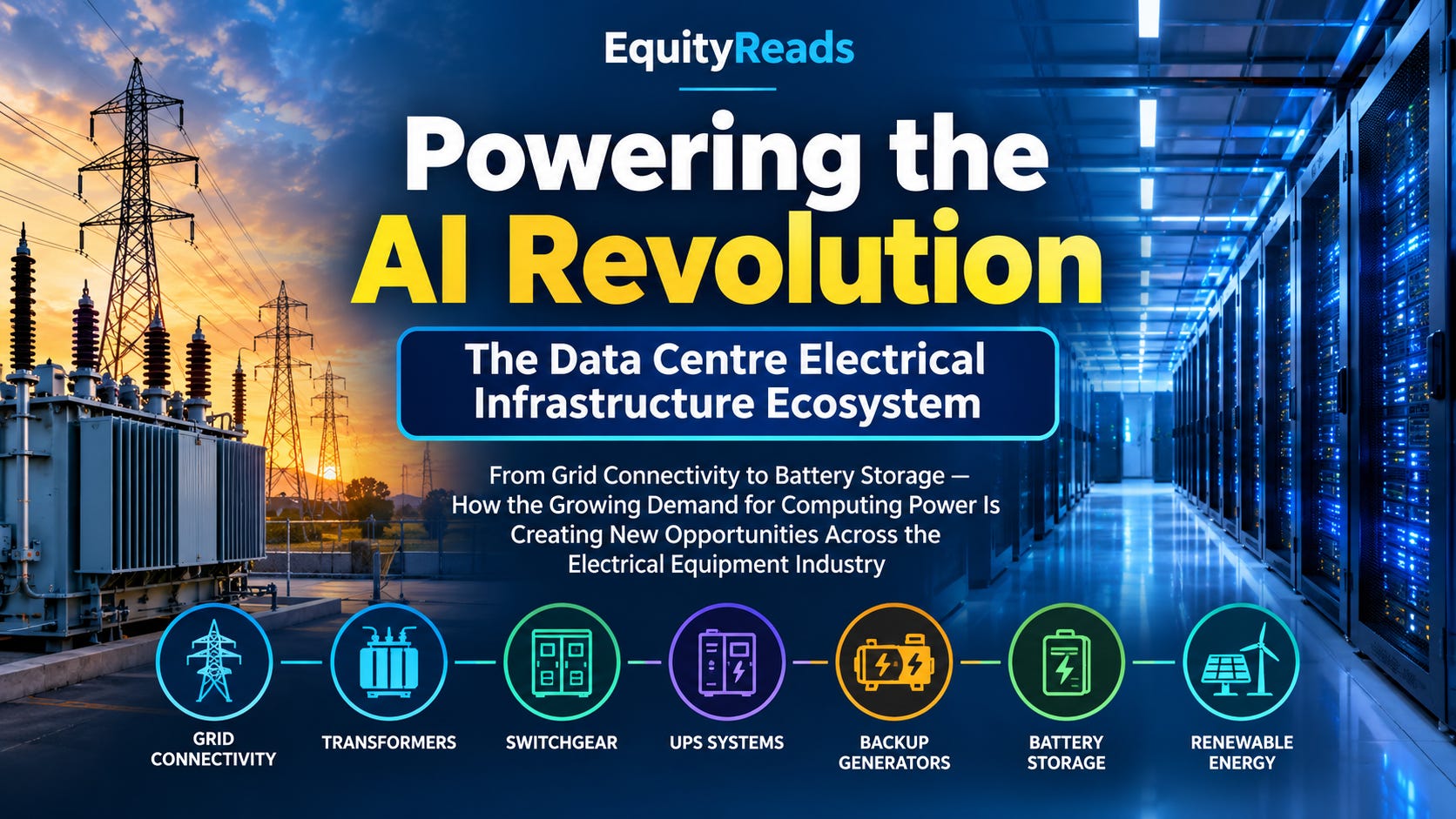
The ecosystem has three connected stages:
Power sourcing: Grid connections, electricity generation, renewable procurement and adequate transmission capacity.
Power conversion and distribution: Transformers, switchgear, UPS systems, panels, busways, cabling and power distribution units.
Continuity and optimisation: Backup generators, battery storage, monitoring, energy management and efficiency solutions.
Power sourcing secures supply; distribution delivers it safely to computing equipment; and continuity systems help operations withstand interruptions. The precise mix depends on facility size, location, workload, redundancy design and reliability requirements.
Grid Connectivity: The First Bottleneck
Before a data centre can operate, it needs access to a sufficiently large and reliable electricity supply. AI-focused sites—can concentrate substantial demand in a limited area, making grid connections, substations and transmission capacity important factors in site selection.
A project can be delayed even when land, buildings and computing equipment are ready if power connections or grid upgrades are not.
The Critical Equipment: From Transformers to Storage
Transformers and switchgear: Transformers adapt voltage levels for transmission and facility use; switchgear, circuit breakers and protection systems control, isolate and protect electrical circuits. Data centres may require multiple units and layers of protection, depending on capacity and redundancy. Manufacturers with suitable products, proven reliability, available capacity and strong execution may be better placed to capture demand.
UPS and power distribution: UPS systems bridge short interruptions and help protect sensitive computing equipment from power disturbances while the supply is restored or backup generation starts. Panels, busways, power distribution units, cabling and monitoring then deliver electricity to the required locations. Higher AI rack density can require more capable distribution architecture and upgrades to existing facilities.
Backup generators: Diesel generator sets can provide resilience during longer grid interruptions, while UPS batteries cover the immediate gap within their designed limits. Generator systems also require fuel handling, controls, switchgear, testing and maintenance. Their outlook will be shaped by emissions rules, noise restrictions and alternative backup technologies.
Renewable power and battery storage
Data-centre operators may use solar, wind, power-purchase agreements or open-access arrangements to manage electricity costs and emissions. Because renewable output varies, grid support, storage and energy management remain important. Battery systems can support short-duration backup, peak management and renewable integration, but their economics depend on cost, duration, degradation, safety and application. Storage should not automatically be treated as a full replacement for grid supply or long-duration backup.
Why AI Is Changing the Demand Equation
Three forces matter most: higher power density as AI accelerators and dense server configurations concentrate electricity demand; expanding total capacity as cloud and AI workloads grow; and greater emphasis on securing reliable power on schedule. These forces can support demand for electrical equipment, grid upgrades, backup systems and energy optimisation.
The pace and scale of the opportunity will still depend on project execution, grid constraints, AI spending cycles and whether data-centre operators can monetise the capacity they build.
Where Investment Opportunities May Emerge
Transformers and high-voltage equipment: Suppliers of transformers, substations and grid connection systems.
Switchgear and protection: Manufacturers of medium- and low-voltage equipment, breakers and controls.
UPS and power electronics: Providers of uninterrupted power, conversion equipment and integrated power management.
Electrical distribution: Suppliers of panels, busways, power distribution units, cables and connectors.
Backup power: Generator and engine manufacturers, integrators and maintenance providers.
Renewables and storage: Businesses involved in renewable integration, batteries and energy management.
Engineering and computing infrastructure: Companies designing, building, commissioning or maintaining facilities, as well as suppliers of AI servers and high-performance computing systems.
For Indian-equity investors, the central question is not simply which companies operate in which sector. It is which have the technical capability, manufacturing capacity, customer relationships and commercial positioning to convert demand into sustainable earnings. A manufacturer may have little direct data-centre exposure, so confirm customer wins, disclosed orders, end-market revenue and management commentary.
What Investors Should Check Before Buying
Order-book quality: Are orders tied to confirmed projects? Check execution schedules, cancellations, delivery commitments and customer concentration.
Actual revenue exposure: Establish how much revenue comes from data centres and associated power infrastructure rather than assuming the theme is material.
Margins and competition: Determine whether new orders are profitable or whether pricing pressure is eroding returns.
Cash flow and working capital: Compare operating cash flow with reported profits and monitor inventory, receivables and the cash-conversion cycle.
Capacity and CAPEX: Assess whether growth can be served by existing facilities or requires investment, borrowing and higher depreciation.
Competitive position: Look for technical capability, customer approvals, service networks and the ability to deliver complex systems.
Valuation: Consider whether the share price already assumes years of strong growth; even a good business can disappoint if expectations are excessive.
Key Risks
Grid and project delays: Power connections, permits, financing and supporting infrastructure can postpone commissioning.
Overinvestment: Spending ahead of monetisable AI demand could lead to project delays or cancellations.
Valuation excesses: Popular theme-linked stocks may leave little room for execution disappointments.
Margin and cash-flow pressure: Competition, commodity costs and large working-capital needs can weaken cash generation despite revenue growth.
Technology and regulation: Changes in computing efficiency, cooling, power architecture, emissions rules, tariffs, water availability and local planning may alter project economics.
Customer concentration: Dependence on a few customers or large projects can make orders and earnings volatile.
Conclusion: Follow the Power, Not Just the AI Narrative
AI needs computing capacity, and computing capacity needs dependable electricity. Transformers, switchgear, UPS systems, generators, distribution equipment, renewable integration and storage each play a distinct role in keeping data centres running. The opportunity therefore extends beyond software, chips and data-centre owners to the physical infrastructure supporting the digital economy.
The most resilient businesses may be those that can benefit from several overlapping cycles—data-centre construction, grid modernisation, renewable integration, storage and broader electrification—rather than relying on one theme alone. Investors should prioritise proven exposure, execution, sustainable margins, operating cash flow, return on capital and reasonable valuations. Follow confirmed orders and fundamentals, not the narrative alone.
Disclaimer
This report is intended solely for educational and informational purposes. It presents a general analysis of the data-centre electrical infrastructure ecosystem and its potential investment implications. It does not constitute investment advice, a recommendation to buy or sell any security, or a promise of future returns.
Industry growth expectations and investment opportunities are subject to technological, regulatory, economic and market uncertainties. Company-specific decisions should be based on independent research, verified financial disclosures, actual business exposure, risk tolerance and valuation. Consult a qualified financial adviser where appropriate. Past performance and anticipated industry growth do not guarantee future returns.
ANNEXURE
Listed Indian Companies in the Data Centre Ecosystem
This company-wise reference list identifies the basis for each company’s relevance to the data-centre value chain. It does not imply that every company has material data-centre revenue.
Transformers, Switchgear and Power Infrastructure
Hitachi Energy India — Supplies high-voltage transformers, switchgear, substations and power-quality solutions for large electricity loads.
Siemens Energy India — Exposed to transmission, grid technology and electrical infrastructure, primarily at the power-supply end.
CG Power and Ind Solutions — Makes transformers, switchgear, motors and other electrical equipment; confirm specific data-centre orders or revenue.
GE Vernova — Supplies transmission and substation equipment that may benefit from grid-capacity expansion.
Voltamp Transformers — Makes power and distribution transformers used across commercial and industrial infrastructure.
Marine Electricals — Merits closer investigation because the source report identifies reported data-centre-specific orders alongside its electrical systems business.
UPS, Switchgear and Power Distribution
ABB India — Provides electrification, switchgear, power-protection and automation products relevant to facility power systems.
Schneider Electric Infra — Its listed Indian entity focuses on electrical distribution equipment, including transformers and switchgear; the global group’s broader UPS portfolio should not be assumed to represent this entity’s revenue.
Siemens — Supplies electrical distribution, automation and industrial technology; assess the specific exposure before attributing data-centre benefits.
Backup Power and Generators
Cummins India — Makes engines and power-generation equipment relevant to backup generation; verify the scale of data-centre demand.
Kirloskar Oil Engines — Makes engines and generator sets; confirm actual data-centre customer exposure.
Renewable Power, Grid Capacity and Energy Storage
Tata Power — Exposure to power generation, distribution and renewables may be relevant to reliable, lower-carbon electricity supply.
JSW Energy — Operates in power generation, renewables and storage; assess actual procurement agreements and projects tied to data-centre demand.
Power Grid Corporation — Potential indirect beneficiary of transmission expansion; its performance is driven primarily by regulated transmission investment.
Exide Industries — Battery exposure may serve backup and storage applications; confirm product suitability and adoption in large data centres.
Amara Raja Energy — Battery and storage technologies may support backup-power applications, subject to product fit and customer adoption.
Engineering, Construction and Data Centre Infrastructure
Larsen & Toubro — Electrical engineering, EPC and infrastructure execution capabilities may support data-centre and associated power projects.
Techno Electric & Engg — Offers power-infrastructure and data-centre-development exposure; assess its pipeline and project execution.
KEC International — Transmission, substations and electrical infrastructure create potential indirect exposure to grid investment supporting data-centre loads.
Netweb Technologies — Supplies AI computing infrastructure, servers and high-performance computing systems; a computing-infrastructure play rather than a conventional electrical-equipment maker.
Priority Names for Further Research
The original report highlights these eight companies for an initial focused review. This is a research shortlist, not a ranking by expected stock returns.
Marine Electricals — Review disclosed data-centre orders, execution, customer concentration, margins and cash conversion.
ABB India — Assess electrification, distribution, protection and broader electrical-infrastructure exposure.
CG Power and Ind Solutions — Verify the extent of data-centre-linked orders or revenue.
Hitachi Energy India — Review high-voltage equipment and grid-connectivity exposure.
Siemens Energy India — Assess transmission and grid technology relevant to large power loads.
Cummins India — Examine backup-generation demand and customer exposure.
Voltamp Transformers — Track transformer demand and evidence of orders linked to relevant projects.
Techno Electric & Engg — Assess power-infrastructure execution and data-centre development exposure.
Research Caveat
Before investing, review each company’s latest annual report, quarterly results, data-centre-specific order disclosures, five-year sales and operating cash-flow trends, return on capital, debt and current valuation. The report does not assess live share prices or valuations; this annexure is a company-reference aid, not a buy recommendation. Where direct exposure is not established, treat the link to data-centre growth as potential or indirect until supported by company disclosures.
ur actual revenue exposure check already has an answer for cummins.. mgmt said data centres were 40% of domestic power gen revenue last quarter, and going by the numbers the rest of power gen grew only single digit
ge vernova t&d meanwhile called its dc orders not significant yet