


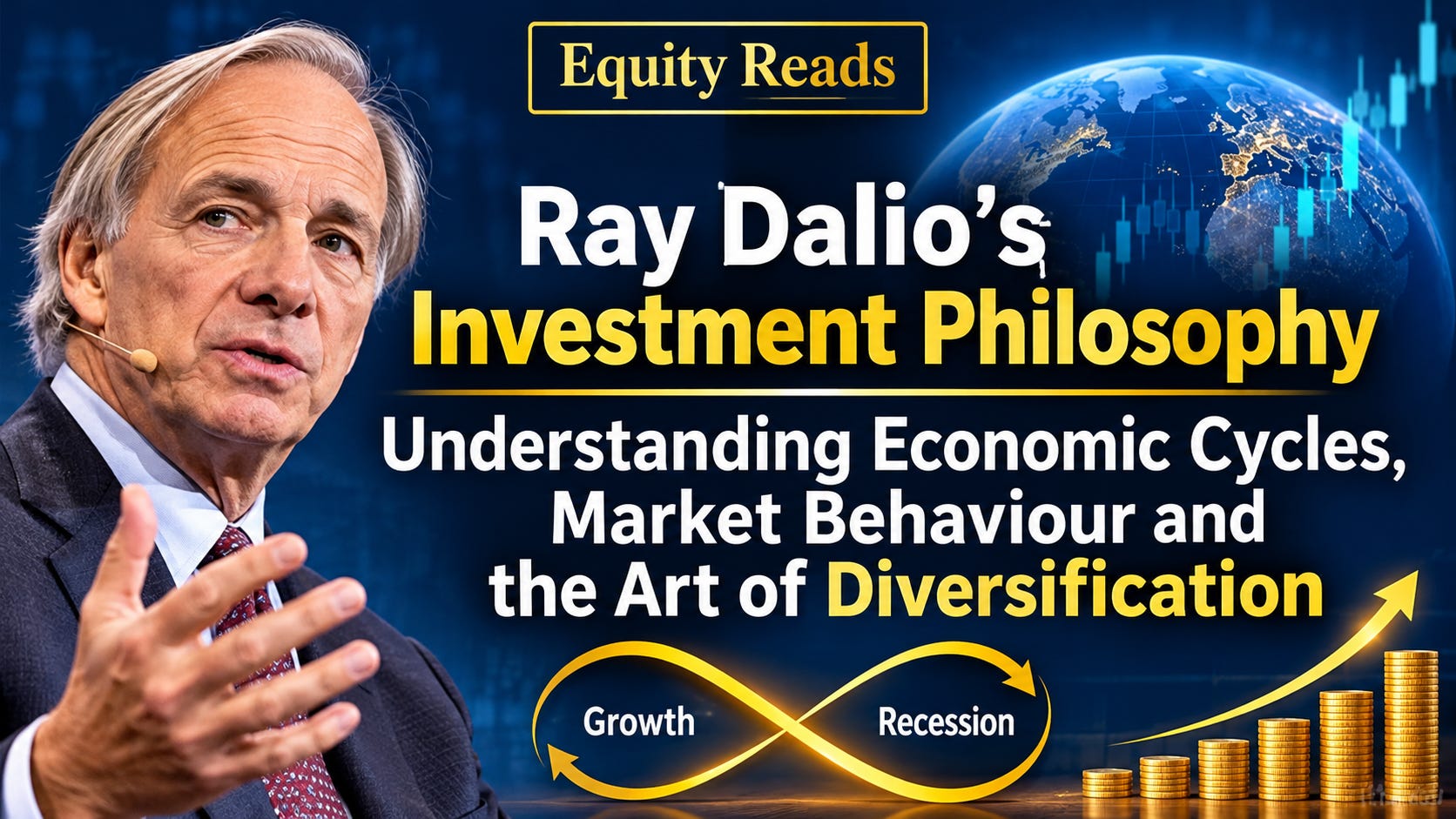
What Really Drives Investment Returns?
Why do fundamentally strong companies sometimes fall despite good results, while markets rise amid economic weakness?
The answer often lies beyond individual businesses—in debt, interest rates, liquidity, investor expectations and broader economic forces.
Ray Dalio, founder of Bridgewater Associates, built his investment philosophy around understanding these interconnected forces. His framework offers investors a way to look beyond short-term price movements and assess what drives economic activity, asset valuations and investment risk.
The central question is simple: Is a good business also a good investment at its current price, and can the portfolio withstand changing economic conditions?
A System of Interconnected Forces
Dalio identifies following three major forces shaping the economy.
Productivity: Innovation, technology & efficiency drive sustainable growth and improve business competitiveness. AI is a current example, but technological potential alone does not make every related stock attractive.
Short-term debt cycle: Lower interest rates encourage borrowing and spending, supporting growth. Excessive demand can fuel inflation, prompting central banks to tighten policy.
Long-term debt cycle: When debt grows faster than the income available to service it, financial vulnerabilities build. Rising repayment costs can eventually constrain economic growth.
Investment lesson: Look beyond headline growth. Focus on productivity, cash flows, debt-servicing capacity and sustainable earnings.
The Price of Money Matters
Central banks influence economic activity through interest rates, credit and liquidity, while governments shape demand through taxation, spending and borrowing.
Lower interest rates can support equity valuations by reducing financing costs and discount rates. However, if rates fall because the economy is weakening, declining earnings may offset the benefit. Higher rates can pressure valuations and make fixed-income investments more attractive.
Investment lesson: Understand why policies are changing, not just their direction. Their impact on growth, inflation and corporate earnings matters more than the headline decision.
Debt Sustainability and the Changing Global Economic Order
Dalio argues that public debt, currency confidence and geopolitical influence shape the rise and decline of major economic powers. Technology, education, productivity, trade competitiveness and financial strength can reshape global supply chains, currencies and investment flows.
In a statement to the US House Budget Committee on 26 March 2026, Dalio advocated reducing the US federal budget deficit to 3% of GDP. This was a policy recommendation, not an achieved outcome.
The broader message is that investors should not assume today’s global economic order will remain unchanged.
A Good Business Is Not Always a Good Investment
An asset’s value depends on the present value of its expected future cash flows. This is influenced by the amount and timing of those cash flows, the discount rate and the risks involved.
When interest rates or required returns rise, the present value of future cash flows generally falls. Companies whose expected profits lie far in the future can be particularly sensitive.
The distinction is crucial: business quality and investment attractiveness are not the same. Even an excellent company can deliver disappointing returns if purchased at an excessive valuation.
Investment lesson: Assess both the quality of a business and the price paid for its future earnings potential.
Markets Price Expectations, Not Just Results
Share prices reflect expectations about future earnings, interest rates, inflation and risk—not simply reported performance. Strong results can disappoint if expectations were higher, while weak results may trigger a recovery if the outlook improves.
This is where fundamental and technical analysis complement each other. Fundamentals assess business quality and valuation; technicals help evaluate price trends, volume and market sentiment.
Investment lesson: Determine what a business may be worth, then assess whether market behaviour offers a sensible entry and risk-reward opportunity.
Beta and Alpha: Understanding Investment Returns
Beta measures an investment’s sensitivity to broader market movements, while alpha represents performance above or below an appropriate benchmark after accounting for the relevant risk framework.
A rising portfolio does not necessarily demonstrate superior stock selection; it may simply reflect a rising market.
Investment lesson: Measure performance against the right benchmark and distinguish market-driven returns from genuine outperformance.
More Holdings Do Not Always Mean Less Risk
Owning several companies does not guarantee diversification if they are exposed to the same sectors or economic forces. Effective diversification requires investments with different sources of return and varying responses to market conditions.
Dalio also distinguishes capital allocation from risk allocation. Equal investments in equities and bonds do not necessarily contribute equally to portfolio risk. Combining investments with low correlations can reduce overall risk, although correlations may rise during market stress.
All-Weather Philosophy: Preparing for Different Economic Environments
Dalio’s All Weather approach seeks to balance portfolio risk across four environments: stronger or weaker economic growth, combined with higher or lower inflation.
It spreads exposure across asset classes such as equities, government bonds, inflation-linked bonds and commodities, recognising that they respond differently to economic conditions.
The approach does not guarantee positive returns in every environment and may lag equity-heavy portfolios during strong stock-market rallies.
Investment lesson: Build portfolios for different economic possibilities rather than relying on a single forecast.
Dalio’s Recent Views: AI Valuations and US Fiscal Risks
On 5 January 2026, Reuters reported Dalio’s warning that the AI-driven equity boom was showing early signs of a bubble, reflecting concerns about valuations and investor expectations. This was a caution, not a prediction of an inevitable market collapse.
His March 2026 comments on US fiscal sustainability similarly highlighted the risks of rising public debt.
The distinction is important: a technology can transform the economy while its associated stocks remain overvalued.
Investment lesson: Question whether valuations are supported by sustainable cash flows and whether portfolios can withstand changes in liquidity, interest rates and market sentiment.
Applying Dalio’s Philosophy: A Practical Framework
Dalio’s principles can be translated into a disciplined equity-investment process:
Assess business quality: Examine profitability, cash flows, returns on capital, debt and competitive strength.
Understand the economic cycle: Monitor interest rates, inflation, liquidity, currencies and geopolitical risks.
Evaluate valuation: Compare market prices with sustainable earnings and future cash-flow potential.
Confirm market trends: Use Weinstein stages, moving averages, RSI, GMMA, relative strength and volume to assess entry opportunities.
Control risk: Define entry levels, position sizes and acceptable losses.
Stay systematic: Record investment assumptions and review performance against an appropriate benchmark.
Investment lesson: Combine sound businesses, sensible valuations, favourable market trends and disciplined risk management.
Conclusion: Invest With a Process, not a Prediction
Dalio’s philosophy reminds investors that markets are shaped by productivity, debt, policy, geopolitics, expectations and risk. None can be predicted with certainty.
Its enduring value lies in the discipline it encourages, understand the economic environment, assess business quality, respect valuations, use technical confirmation and diversify intelligently.
The objective is not to avoid every mistake, but to ensure that no single mistake threatens the portfolio.
Disclaimer
This report is prepared for informational and educational purposes only. It should not be construed as investment advice, a recommendation to buy or sell any security or a solicitation to invest. It reflects an interpretation of Ray Dalio’s published investment philosophy and selected publicly available material and does not represent an endorsement by Ray Dalio or Bridgewater Associates. The writer has no association with Ray Dalio or Bridgewater Associates and has not contacted them for this research. Readers should independently verify information and conduct their own research before making investment decisions.