


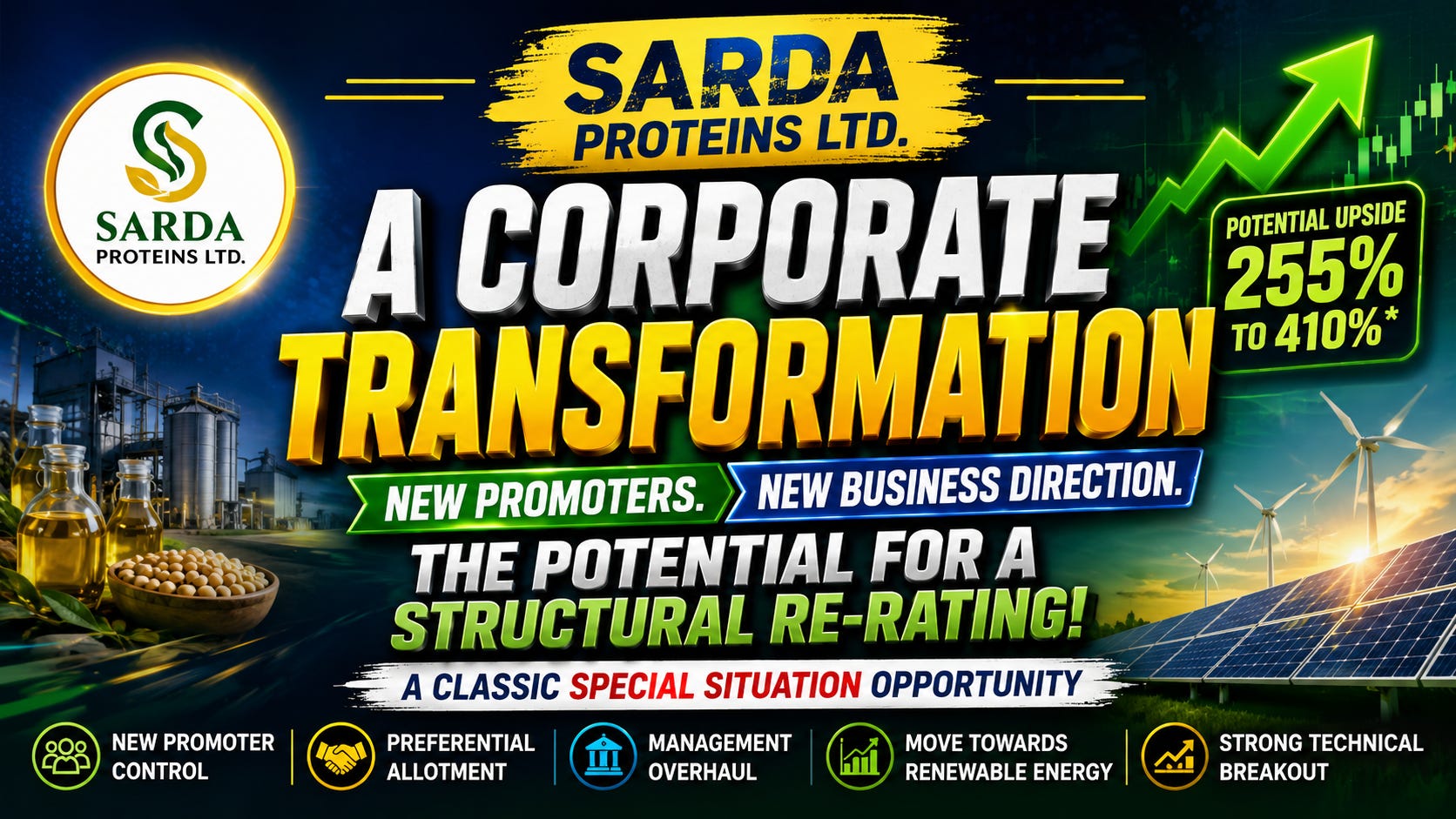
Every market cycle produces a few special situation investments, where the opportunity is driven not by historical financial performance but by transformative corporate events such as changes in ownership, management or business direction.
Sarda Proteins appears to fit this framework. During 2026, the company underwent a comprehensive transformation involving a complete change in control, induction of a new promoter group, preferential allotment, management and board restructuring, relocation of its corporate office, a proposed rebranding to Onix Power Ltd, and early indications of a strategic shift towards renewable energy.
Collectively, these developments have fundamentally changed the company’s investment narrative. Rather than being valued solely on its legacy edible oils business, investors are now assessing its potential to emerge as a renewable energy-focused operating company.
The stock has already responded with a strong technical breakout supported by improving volumes and momentum. However, long-term value creation will ultimately depend on the new management’s ability to successfully execute its transformation strategy over the coming quarters.
Why This Is a Special Situation
Unlike conventional value investing, where decisions are based primarily on earnings history and valuation metrics, special situation investing focuses on companies undergoing significant corporate events that may reshape their future.
Sarda Proteins currently exhibits several characteristics commonly associated with successful corporate transformations:
Complete change in promoter group
Acquisition of management control under the SEBI Takeover Regulations
Preferential capital infusion
Board and management restructuring and proposed corporate rebranding
Indications of business diversification into renewable energy
Strong technical breakout following months of consolidation
The investment thesis therefore rests not on the company’s historical performance but on the ability of the new promoters to successfully execute their long-term strategy.
Corporate Transformation - Complete Change in Control
Management control changed hands through the formal takeover process prescribed under the SEBI Takeover Regulations, including the Public Announcement, Detailed Public Statement, Letter of Offer and Post Offer Advertisement.
The structured acquisition indicates a planned change in ownership rather than ordinary market accumulation, a pattern often seen before corporate restructuring.
New Promoter Group
Control of the company now rests with Onix Renewable, which holds 78.24% of the equity. In addition, Piyush Mansukhbhai Savalia and Divyeshkumar M Savalia hold 1.31% and 1.11%, respectively, taking the combined promoter holding to approximately 80.66%.
A promoter stake of this magnitude demonstrates strong alignment with the company’s long-term transformation while significantly reducing the public free float, a factor that can amplify price movements during periods of heightened investor demand. Investors should, however, continue monitoring future changes in shareholding, promoter pledging and any further equity dilution.
The new promoter group brings nearly two decades of experience in the power and renewable energy sector. This group has evolved from an electrical infrastructure company into an integrated renewable energy enterprise with capabilities spanning solar EPC, solar module manufacturing, wind and hybrid energy projects, power transmission and distribution and operations & maintenance.
Under the leadership of Divyesh Savaliya and Piyush Savaliya, the group has built a track record in executing renewable energy projects across India, lending greater credibility to Sarda Proteins’ proposed transition into the renewable energy sector.
Management, Governance and Operational Restructuring
One of the clearest indications of the new promoters’ long-term commitment is the comprehensive restructuring undertaken following the change in control. The erstwhile Managing Director resigned, new directors were inducted, an Independent Woman Director was appointed, and the Audit Committee, Nomination & Remuneration Committee, and Stakeholders’ Relationship Committee were reconstituted, reflecting a strengthened governance framework. Simultaneously, the Board approved the relocation of the registered office within Alwar, Rajasthan, and established a new corporate office in Rajkot, Gujarat.
These operational changes may appear administrative; they are associated with broader organizational realignment and are consistent with the strategic transformation initiated by the incoming promoter group. Collectively, these developments suggest that the new promoters intend to actively build and expand the business rather than remain passive financial investors.
Proposed Corporate Rebranding
The company has proposed changing its name from Sarda Proteins Ltd to Onix Power Ltd. Corporate rebranding frequently accompanies strategic repositioning. While a name change alone creates no value, it often signals management’s intention to align the company’s identity with its future business model.
Business Transition
One of the most significant developments appears in the June 2026 quarterly financial statements, where the company reports operating in a single business segment described as:
“Renewable Energy Sector – Solar Cell Products.”
This represents a notable shift from its historical edible oils and agri-products business. Although still at an early stage, it may be the first operational indication that the company is transitioning towards renewable energy. The coming quarters will determine whether this evolves into a sustainable operating business.
Financial Performance
The latest quarterly results show encouraging early signs of improvement:
Revenue from Operations: ₹1,299 lakh
Total Revenue: ₹1,847 lakh
Net Profit: ₹166 lakh
Compared with the corresponding quarter of the previous year, the company has moved from losses to profitability. While encouraging, one profitable quarter is insufficient to establish a long-term trend. Investors should assess whether future earnings are supported by recurring operating performance rather than one-off income.
Why Has the Stock Become Active?
The recent appreciation appears to reflect changing market expectations rather than historical financial performance. The market is increasingly pricing in possibilities such as:
renewable energy expansion,
business diversification,
capital infusion,
strategic restructuring,
value unlocking, and
successful execution by the new promoter group.
The promoter change, preferential allotment, management overhaul and proposed rebranding have already occurred. The success of the underlying business transformation, however, remains to be demonstrated through consistent operational performance.
Technical Analysis
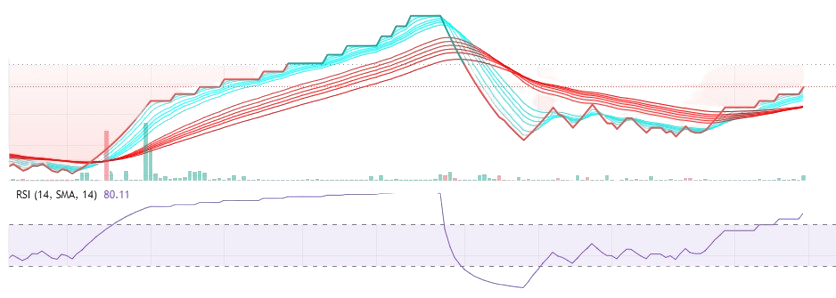
The stock appears to have completed a classic accumulation pattern comprising:
an initial uptrend,
a sharp correction,
prolonged consolidation, and
a decisive breakout above the GMMA ribbon.
The GMMA structure has turned bullish, with short-term averages positioned above long-term averages and the ribbon continuing to widen, indicating improving trend strength. RSI is currently near 80, reflecting strong momentum but also suggesting that the stock may be overextended in the short term. Periods of consolidation or moderate corrections would therefore be normal. Importantly, the breakout has been accompanied by improving trading volumes, increasing confidence that the move is supported by genuine buying interest.
Key Catalysts
The next 6–12 months will largely determine whether the current re-rating develops into a sustainable long-term growth story. Investors should monitor:
approval of the proposed name change,
expansion of renewable energy operations,
capital expenditure,
additional fund raising,
quarterly revenue growth and operating margin improvement,
execution of solar-related projects,
related-party transactions,
promoters share pledging, and
strategic acquisitions or business transfers into the listed company.
Investment Thesis
Sarda Proteins is no longer being evaluated on the basis of its historical edible oils business. Instead, investors are attempting to assess the future business that may emerge under the new promoter group.
The investment case therefore depends primarily on the successful execution of the renewable energy strategy, disciplined capital allocation, improving profitability and strong corporate governance.
This is precisely what defines a classic special situation investment.
Key Risks
Despite the improving narrative, investors should remain aware of several important risks:
Execution Risk: The transformation could take longer than expected.
Business Transition Risk: Renewable energy operations may not generate sustainable profitability.
Valuation Risk: Market expectations may run ahead of business fundamentals.
Liquidity Risk: High promoter ownership reduces free float and may increase price volatility.
Technical Risk: With RSI near 80, short-term corrections remain a realistic possibility.
Outlook
Short-Term
The technical structure remains constructive following the breakout. However, with momentum indicators stretched, consolidation or moderate corrections would be healthy before the next advance.
Medium-Term
During this period, the investment story will shift from technical momentum to operational execution. Revenue growth, profitability, capital allocation and progress in renewable energy operations will determine whether the market continues to re-rate the company.
Long-Term
If the company successfully transforms into a scalable renewable energy business supported by sustained revenue growth, improving margins, disciplined governance and efficient capital allocation, the market may begin valuing it as an emerging growth company rather than a legacy edible oils business.
Optimistic Bull Case
This scenario assumes exceptional execution, successful scaling of renewable energy operations, consistent profitability, institutional investor participation and strong capital allocation. While the upside could be substantial, this should be viewed as an optimistic scenario rather than the base case.
Conclusion
Sarda Proteins has undergone one of the most comprehensive corporate transformations seen in a micro-cap company in recent years. A complete promoter change, promoter consolidation, management restructuring, governance overhaul, proposed rebranding and early evidence of a transition towards renewable energy have fundamentally changed the investment narrative.
The market has begun recognising this shift, as reflected in the stock’s strong technical breakout and improving trading volumes. Nevertheless, the long-term investment outcome will depend not on announcements but on the management’s ability to deliver sustained improvements in revenue, profitability, capital allocation and corporate governance.
For investors willing to accept the risks associated with micro-cap and special situation investing, Sarda Proteins represents a closely watched transformation story. The foundations have been laid; the next several quarters will determine whether they develop into a durable, profitable and scalable business capable of creating long-term shareholder value.
Disclaimer
This report is intended solely for educational and informational purposes and should not be construed as investment, financial, legal, accounting or tax advice, nor as a recommendation to buy, sell or hold any security. The analysis is based on publicly available corporate disclosures, regulatory filings, financial statements and technical observations available at the time of writing. Forward-looking statements and price targets represent analytical opinions rather than guarantees of future performance. Micro-cap and special situation investments involve significant risks, including execution, liquidity, governance, regulatory and valuation risks.
Investors should conduct their own independent due diligence and consult a qualified financial adviser before making any investment decision.
Excellent analysis sir 🙏