


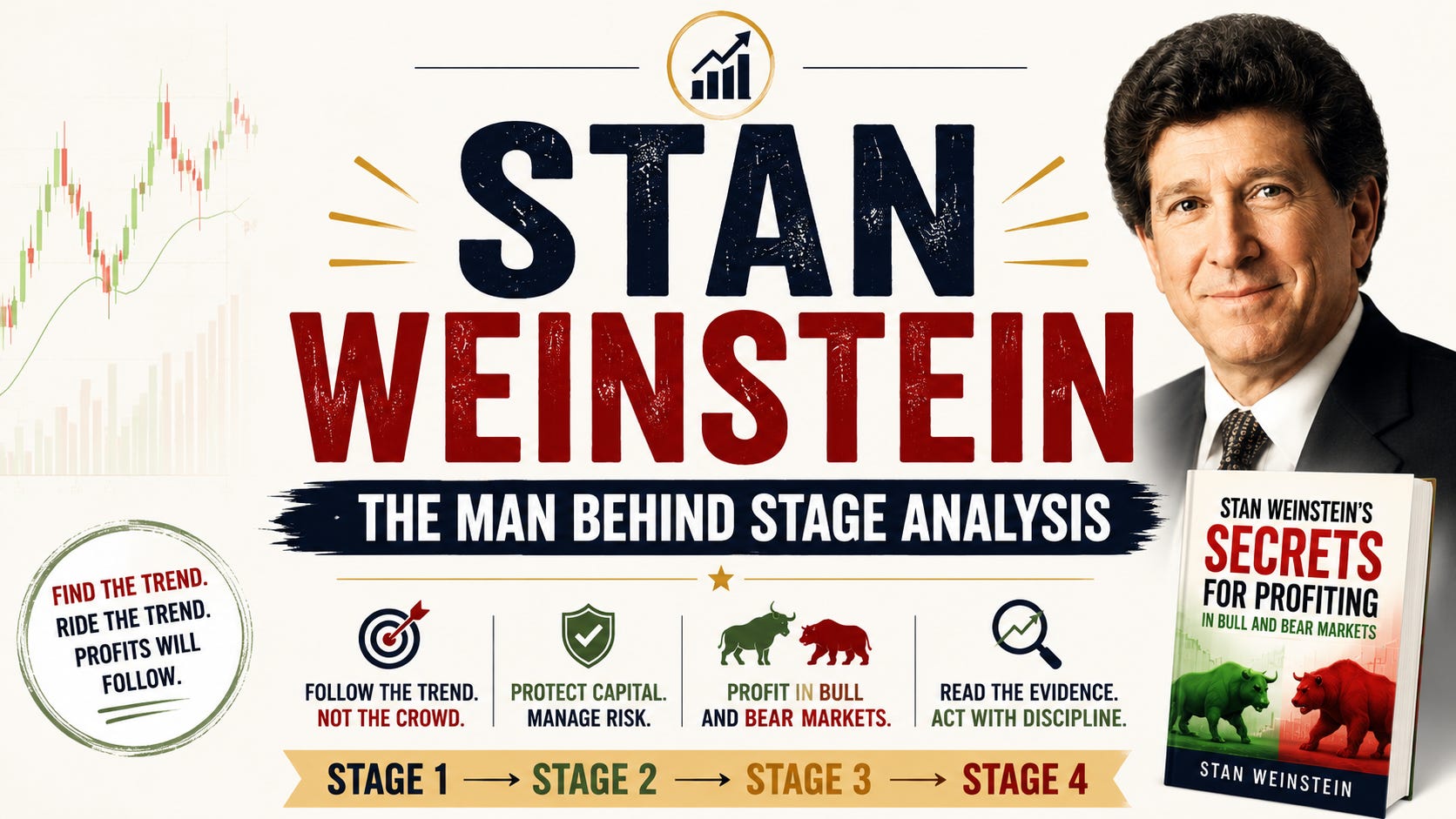
Before learning Stage Analysis, it’s worth understanding the mindset behind it. Stan Weinstein, author of Secrets for Profiting in Bull and Bear Markets, believed that successful investors don’t predict the market—they follow the evidence.
His philosophy combines price, volume and trend into a simple framework that helps investors identify where a stock stands in its life cycle and make disciplined decisions instead of emotional ones.
Read the Market, Not the Headlines
Weinstein believed the market prices in information before it becomes news. Rather than reacting to headlines, earnings stories or forecasts, investors should learn to read what price and volume are revealing in real time.
His philosophy is simple: price reflects expectations and volume reflects conviction. Fundamentals matter, but the market often interprets them before investors do.
The First Rule: Consistency Over Emotion
Weinstein argued that long-term success comes from following a repeatable process, not from constantly searching for more information.
He identified the biggest enemies of investors:
Greed encourages buying after a big rally.
Fear forces selling after a sharp decline.
Hope keeps investors holding losing positions.
His solution was a rules-based approach that removes emotion from decision-making.
Buy Strength, Not Cheapness
Weinstein challenged the popular saying “Buy low, sell high.”
A stock trading 50% below its peak isn’t automatically a bargain—it may simply be in a downtrend. Weinstein preferred buying stocks that are proving their strength by breaking into a new uptrend.
An ideal setup includes:
Breakout above a well-defined resistance level.
Price trading above a rising 30-week moving average.
Strong volume confirming institutional buying.
The goal is to buy when demand begins to overpower supply.
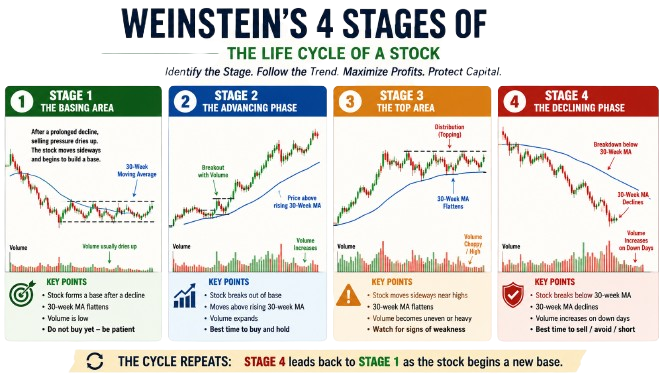
The Four Stages of Every Stock
Weinstein observed that almost every stock moves through four recurring stages—from accumulation to advance, distribution, and decline.
Stage 1 – Basing Phase: After a prolonged decline, the stock moves sideways as selling pressure fades. The 30-week moving average flattens, signaling accumulation and the foundation for a potential new trend.
Stage 2 – Advancing Phase: The stock breaks above resistance with strong volume and trades above a rising 30-week moving average. This is the ideal stage to enter, as a sustained uptrend begins.
Stage 3 – Topping Phase: The uptrend starts losing momentum, and the stock moves sideways or makes limited new highs. A flattening 30-week moving average often signals distribution and a possible trend reversal.
Stage 4 – Declining Phase: The stock breaks below support and the 30-week moving average turns downward. This marks the downtrend, where the focus shifts from finding bargains to protecting capital.
Why the 30-Week Moving Average Matters
The 30-week moving average is the backbone of Weinstein’s methodology because it filters short-term noise and highlights the primary long-term trend.
Every chart should answer three simple questions:
Is price above or below the moving average?
Is the moving average rising, flat, or falling?
Is volume confirming the trend?
It acts as a trend map, not a mechanical buy-or-sell signal.
The Triple Confirmation Formula
A high-quality breakout requires more than price alone. Weinstein looked for three confirmations working together:
Price breaking into a new trend.
Volume expanding on the breakout.
Relative Strength outperforming the broader market.
When all three align, the probability of identifying a true market leader improves significantly.
Market First, Stock Second
Weinstein followed a top-down approach:
Market → Sector/Industry → Stock
A strong stock in a strong sector has a much better chance of sustaining its move than a strong stock in a weak industry. Understanding the broader market trend always comes before selecting individual stocks.
Selling Is a Strategy too
Buying gets you into a trade. Selling determines how much of the trend you actually keep. Weinstein believed exits deserve as much attention as entries.
His principles:
Protect capital with disciplined exits.
Use sell-stops instead of hope.
Don’t aim to sell at the exact top—capture the major trend and exit when evidence changes.
The Philosophy in One Sentence
“Don’t predict what a stock should do. Observe what it is actually doing and act when the evidence changes.”
Why Stan Weinstein Still Matters
Markets have changed dramatically with ETFs, algorithms and instant information but the Human behaviour hasn’t. Fear, greed, supply and demand still leave their fingerprints on price and volume.
Weinstein’s timeless checklist remains relevant:
Is the stock basing, advancing, topping, or declining?
Is the long-term trend rising?
Is volume confirming the move?
Is the stock outperforming the market?
Is the sector and overall market supportive?
The Weinstein Takeaway
Find the trend, Confirm it, Ride the trend, Exit when the trend changes.
That simple philosophy is what makes Stan Weinstein’s Stage Analysis timeless. It teaches investors to stop chasing bottoms, stop fighting trends, and instead participate in the strongest moves while protecting capital when the evidence changes.
Disclaimer: This article is intended solely for educational and informational purposes. It explains Stan Weinstein’s investment philosophy and Stage Analysis framework and should not be considered investment advice or a recommendation to buy or sell any security. Technical analysis is not infallible, and investors should conduct their own research and consider their financial goals and risk tolerance before making investment decisions.