


In equity markets, knowledge is essential, but knowledge alone does not guarantee trading success. A trader may understand technical indicators, chart patterns, volume analysis and fundamental valuation, yet struggle to make consistent decisions when market conditions change.
The 70/20/10 model, originally used as a framework for learning and leadership development, offers a practical way to approach trading.
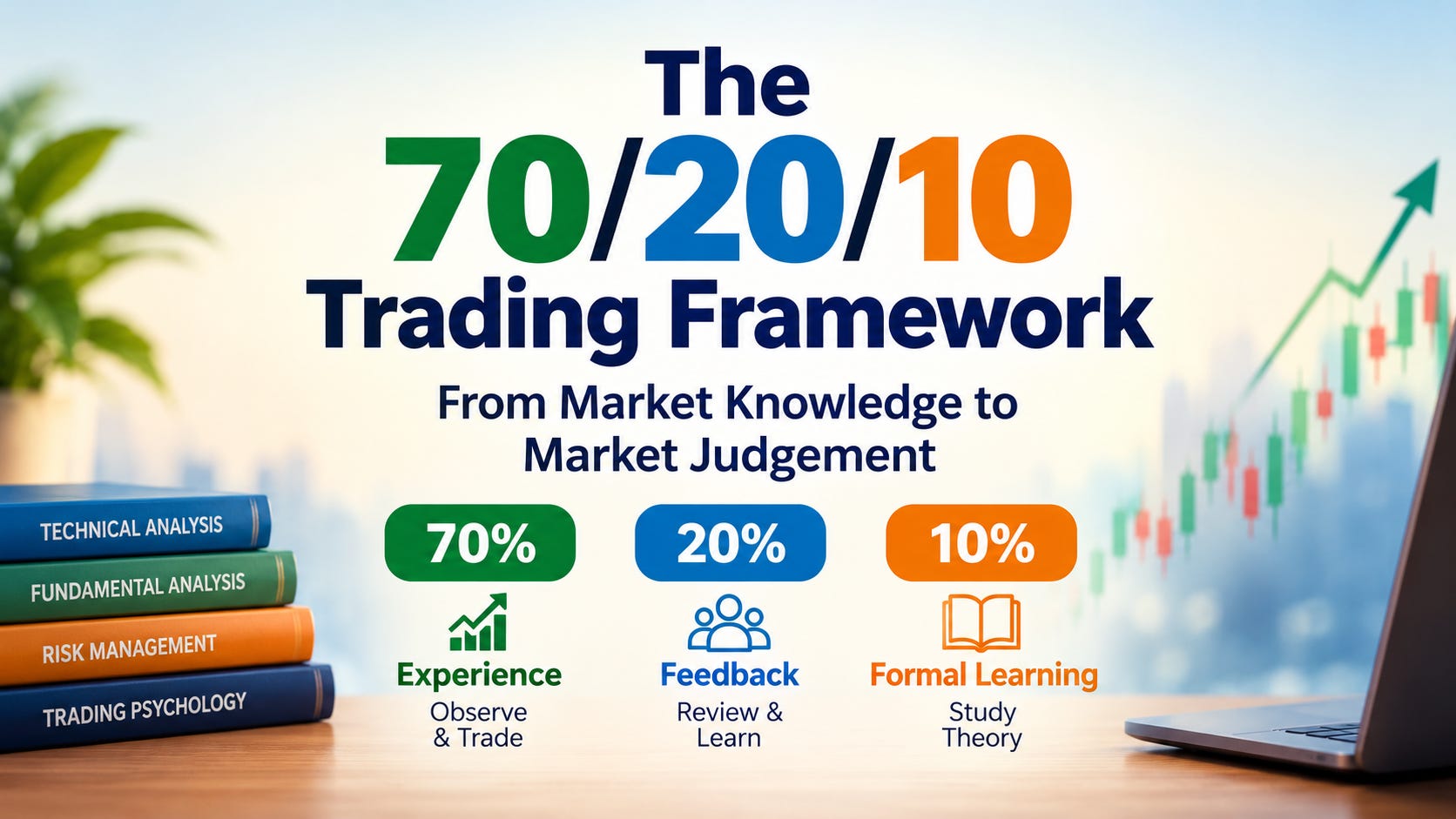
Adapted to the stock market, it emphasizes three pillars: experience, feedback and formal learning. The percentages are a learning framework, not a scientifically established formula for trading success.
The 70% — Experience and Market Observation
The greatest learning comes from observing real market behaviour and applying knowledge in practice. Studying breakouts, reversals, pullbacks and momentum builds a foundation, but experience develops judgement.
When a stock breaks resistance on strong volume, assess whether the breakout sustains, the broader market remains supportive and volume continues to strengthen.
Consider whether the stock is already extended, a pullback is likely, and where the stop-loss should be placed. Track its performance over the next 5, 20 and 60 sessions to evaluate the outcome. The goal is not merely to identify a setup, but to understand when it works, when it fails and why.
The 20% — Feedback, Review and Learning from Others
Experience becomes valuable when reviewed systematically. Maintain a trading journal, analyse winning and losing trades, study historical charts and learn from experienced traders.
Judge decisions by their quality, not just their outcomes. A well-planned trade can lose despite sound analysis, while a profitable trade may result from luck.
Reviewing mistakes helps identify recurring errors, such as chasing extended stocks, entering too early, ignoring market weakness or taking excessive risk. Learn from others but always test their views against evidence.
The 10% — Formal Learning and Theory
Formal learning builds the foundation for understanding markets, covering technical and fundamental analysis, moving averages, volume, valuation, portfolio construction, position sizing and risk management.
However, knowing more indicators does not necessarily make you a better trader.
Without practical observation and disciplined risk management, even extensive theoretical knowledge may fail to deliver sound decisions.
Theory provides the framework; experience & review teach you when to apply it.
Turning the Model into a Practical Trading Process
The 70/20/10 framework becomes practical through continuous learning: Study, Observe, Trade, Record, Review and Adjust. Before each trade, assess the theory, historical evidence and current market behaviour, including price, volume, momentum and market conditions.
Market behaviour deserves particular attention, as textbook setups can fail when conditions change. While beginners focus on breakouts, experienced traders also assess overextension, market breadth and risk-reward.
The real difference lies not in how much one knows, but in how effectively one applies that knowledge with judgement and discipline.
Applying the Framework to Equity Research
For investors combining fundamentals with price action, the framework provides a disciplined approach:
Fundamentals identify quality businesses, growth potential and improving returns on capital.
Technical analysis helps assess entry timing and price confirmation.
Historical reviews reveal how similar setups performed.
Position sizing and risk management limit the impact of incorrect decisions.
Study the stock, observe its behaviour, record the setup, review the outcome and refine the process. The focus should be on evidence, not prediction. No indicator, chart pattern or analytical framework can eliminate market uncertainty.
Conclusion: Build Judgement, Not Just Knowledge
The framework highlights a simple principle: learning builds understanding, experience develops familiarity, and feedback sharpens judgement.
Successful trading is not about mastering every indicator or predicting every move. It is about identifying opportunities, evaluating evidence, managing risk and learning from every outcome.
The percentages are guidelines, not rigid rules or guarantees of returns. Their value lies in emphasising disciplined observation and honest review alongside formal learning. The ultimate goal is not merely to know more about the market, but to respond to its actual behaviour with greater discipline and sound judgement.
Disclaimer
This content is for educational and informational purposes only. The 70/20/10 model is a learning framework, not a scientifically validated formula or guarantee of success.
Equity investing and trading involve market risks, including loss of capital. Nothing herein constitutes investment advice or a buy/sell recommendation. Conduct your own research and consult a SEBI-registered investment adviser where appropriate. Past performance does not guarantee future results.