


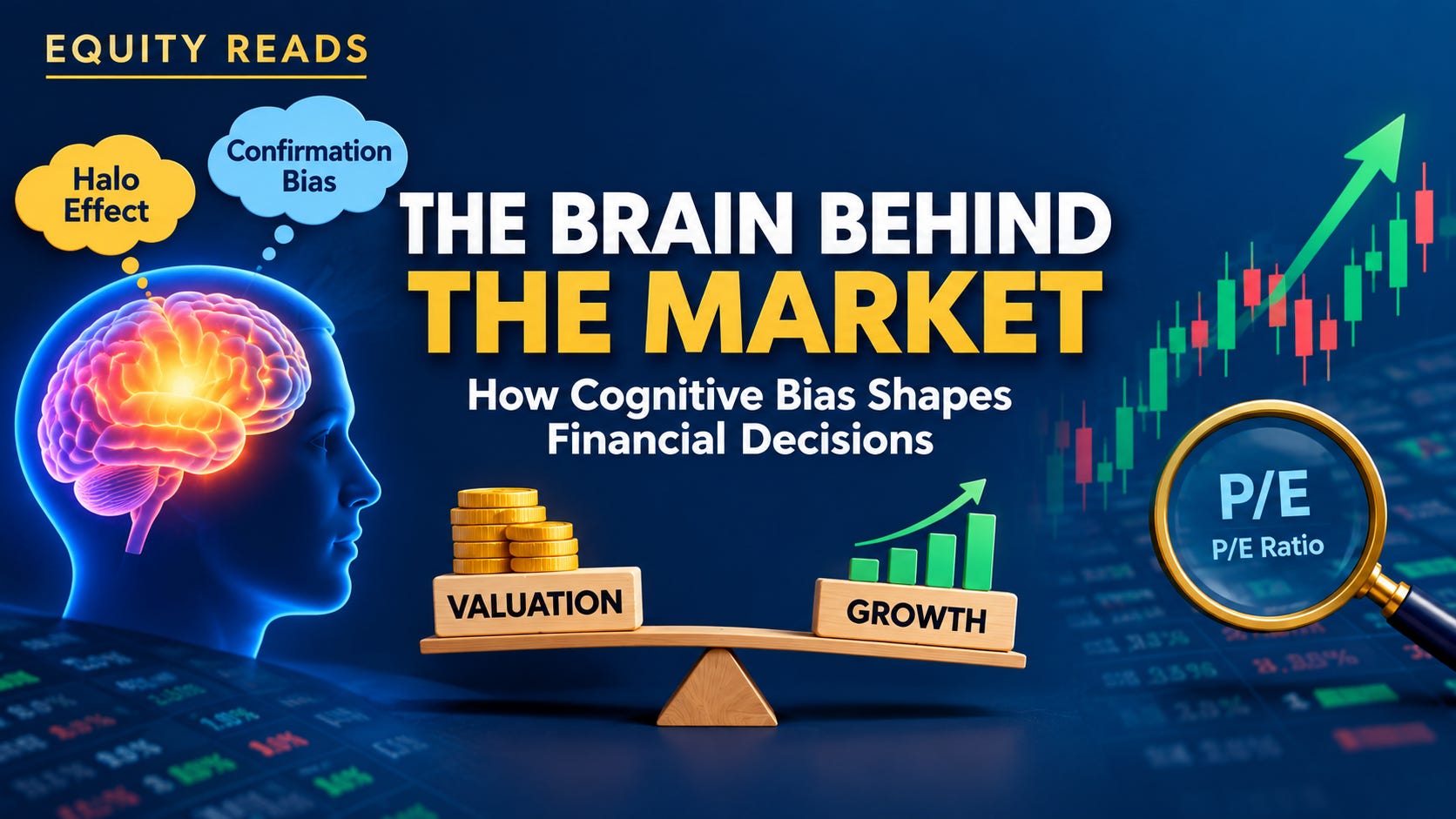
The Brain Does Not Simply Record Reality
The human brain does not function like a camera. It interprets information, fills gaps and shapes perceptions through emotions, expectations and prior beliefs. As a result, our understanding of reality may differ from the available facts.
In the stock market, investors may believe they are making rational decisions based on financial results and valuations, while being influenced by a company’s reputation, a charismatic leader or market sentiment.
Two biases are particularly important:
Halo Effect: One positive characteristic shape our overall judgment of a company, person or investment.
Confirmation Bias: We favour information that supports our existing beliefs while ignoring or discounting contradictory evidence.
These biases affect beginners and experienced professionals alike. Successful investing depends not only on the information we have, but also on how objectively we interpret it.
The Wine Experiment: How Presentation Can Influence Perception
An illustrative story describes a cheap and inexpensive wine receiving favourable reviews after being presented with an attractive label and an air of prestige, while an expensive one without much branding receives less appreciation. Nobody cares about the specific details, including an alleged gold medal, which remains unverified without the original records.
The underlying principle is well recognised: branding, presentation and expectations can influence how we judge quality. A premium label can make a product seem superior, just as a confident presentation can make a weak argument appear convincing.
In the stock market, companies linked to fashionable sectors may attract enthusiasm that spills over into perceptions of their management, growth prospects and valuation.
But a promising industry does not automatically make every company within it a good investment. Investors must look beyond the label and examine the business, its financial strength and the price they are paying.
The Halo Effect in the Stock Market
Investors often make decisions under uncertainty, making them vulnerable to the Halo Effect. A company announcing an ambitious AI expansion may attract enthusiasm because of its growth story, industry appeal and confident management. But a compelling narrative does not guarantee commercial success. A good company is not automatically a good investment at every price. Even strong earnings growth may fail to deliver attractive returns if the stock’s valuation contracts. Conversely, a fundamentally sound business facing temporary difficulties may offer an opportunity when its price falls below a reasonable estimate of its long-term value.
The lesson is simple: look beyond the story and examine the business, its financial strength, valuation and embedded expectations.
Confirmation Bias: Why Investors Defend Their Stocks
Confirmation bias often intensifies after investors buy a stock. Positive news reinforces their decision, while negative developments are dismissed as temporary setbacks.
An investor may welcome a new project as proof of growth potential, excuse delays as external problems and justify fresh fund raising despite the resulting share dilution. When every development is interpreted to support the original decision, confidence grows without improving the analysis.
When the Brain Misreads the Chart
Cognitive biases can distort technical analysis. Traders expecting a reversal may mistake a minor bounce for a bottom, while those anticipating a correction may keep selling into a strong uptrend. In both cases, existing beliefs influence how the chart is interpreted.
This is especially risky in reversal trading, where a genuine trend change can be difficult to distinguish from a temporary recovery. No single indicator guarantees a successful reversal. Combining evidence may help replace wishful thinking with objective analysis.
Remember: Potential upside is not the same as probability of success. The chart should challenge your assumptions, not simply confirm them.
Market Bubbles and the Power of Collective Belief
A rising share price attracts attention and new buyers, pushing prices higher. Investors then interpret these gains as proof that the underlying story is correct, making them less willing to question valuations. This self-reinforcing cycle can eventually disconnect prices from business fundamentals.
Investors should examine earnings quality, margins, cash flow, capital expenditure, debt and valuation to assess whether a company’s prospects justify its market price.
The key question is not how compelling the story sounds, but whether the financial evidence supports the expectations.
A promising business is not automatically a promising investment. The quality of the business, the price paid and the risks involved must all align.
Building a More Rational Decision-Making Process
Knowing about biases is not enough to overcome them. Their influence can be reduced through disciplined, repeatable decision-making.
For investors, six practices are particularly useful:
Document the Thesis: Define the expected return drivers and the conditions that would invalidate the investment.
Separate Facts from Assumptions: Reported revenue is a fact; sustainable future profitability is a hypothesis.
Challenge your Beliefs: Examine credible bearish arguments alongside the bullish case.
Set Risk Rules: Establish entry, exit and risk limits before investing, rather than changing them impulsively.
Review the Process: A profitable trade may result from luck, while a sound decision can still lose money. Evaluate the reasoning, not just the outcome.
Accept Uncertainty: Every forecast and valuation depends on assumptions about an unpredictable future.
These practices cannot guarantee better returns, but they can make decisions more consistent, transparent and evidence based.
The goal is not to eliminate uncertainty, but to make better decisions despite it.
The Greatest Risk May Be the Story, We Tell Ourselves
Investors interpret market movements, financial results and company announcements through the lens of their expectations, emotions and existing beliefs. The Halo Effect can make a company appear more attractive because of its reputation, while confirmation bias encourages investors to defend that view despite contradictory evidence. Together, these biases can lead to overvaluation, premature purchases, delayed exits and misplaced confidence.
The answer is not to reject compelling investment opportunities, but to distinguish between an attractive story, a plausible future and a financially justified investment.
Fundamental investors must focus on business quality, cash generation and valuation. Technical traders must let price action, momentum and risk controls challenge their assumptions rather than merely confirm them.
Ultimately, successful investing requires not only analysing the market but also understanding the mind interpreting it.
A compelling story may deserve attention. Only evidence can establish whether it deserves our money.
Disclaimer
This report is intended solely for educational and informational purposes. It discusses general psychological principles and their potential relevance to financial markets; it does not constitute investment advice, a recommendation to buy or sell any security, or a guarantee of investment performance. The wine example is illustrative, and its specific historical details have not been independently verified. Investors should conduct their own due diligence, evaluate their financial circumstances and risk tolerance, and consult a qualified financial adviser where appropriate. All investments involve risk, including the possible loss of capital.