


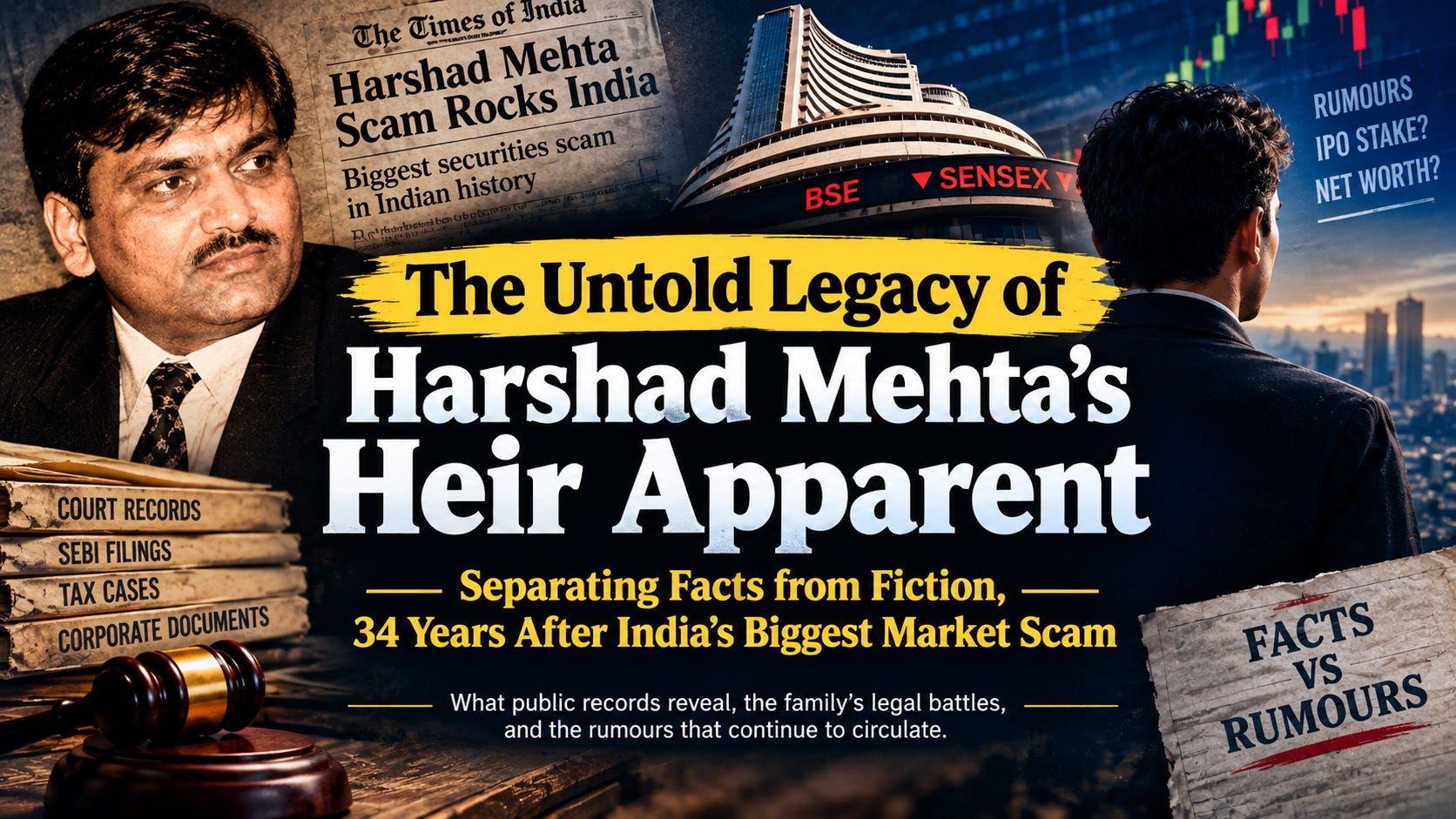
More than three decades after the 1992 securities scam shook India’s financial markets, one question continues to surface on social media, YouTube videos and investment forums:
What happened to Harshad Mehta’s only son, Aatur Mehta?
Every few years, a new claim emerges. Some say he inherited Harshad Mehta’s hidden fortune. Others claim he quietly lives abroad managing billions through offshore entities. The latest rumour links his name to a stake in a major recent IPO.
This report examines what is actually supported by court records, regulatory filings and public corporate disclosures, while separating documented facts from speculation. The investigation is based on the source document available in public domain and intentionally keeps legal discussion concise rather than focusing on individual court verdicts.
The Legacy of 1992 Still Isn’t Over
Harshad Mehta’s story is well known. He became the face of India’s biggest stock market scam after exploiting weaknesses in the banking and securities settlement system through ready-forward transactions and fraudulent bank receipts. The scam fundamentally changed how India’s financial markets operated.
What is less understood is that the legal and financial aftermath did not end with Harshad Mehta’s death in 2001. Recovery proceedings, tax disputes and distribution of attached assets continued for years afterward, making it one of India’s longest-running financial litigation stories.
For investors, the scam’s most enduring impact was not just a market crash—it triggered sweeping reforms that reshaped India’s capital markets.
Who is Aatur Mehta?
Publicly available information about Aatur Mehta is remarkably limited.
According to the source document:
He is the only son of Harshad and Mrs. Jyoti Mehta.
He has maintained an exceptionally low public profile.
Largely stayed away from media, politics and public market commentary.
His name appears occasionally in corporate filings and legal proceedings, but rarely in public life.
That absence from public life has created an information vacuum—one that rumours have repeatedly filled.
The Biggest Myth: Did He Inherit Harshad Mehta’s Fortune?
One of the most widely circulated claims is that Harshad Mehta transferred his wealth to his son before the scam unfolded.
The documents available in public domain presents a different picture.
It states that proceedings before the Special Court indicate Aatur Mehta disclaimed rights in Harshad Mehta’s estate, while Jyoti Mehta represented herself as beneficiary under Harshad Mehta’s will during estate-related proceedings.
This is an important distinction.
The legal record does not establish that Aatur inherited Harshad Mehta’s assets, nor does it support the viral narrative that the family’s entire fortune passed to him.
Why the Mehta Family Stayed in Court for Decades
The post-1992 story became less about the original scam and more about recovering and distributing assets.
According to the report, disputes continued over:
Attached shares.
Properties.
Tax liabilities and refunds.
Distribution of recovered assets.
Interest and penalty calculations.
Rather than reopening the scam itself, much of the litigation revolved around how recovered assets should be distributed among banks, tax authorities and other claimants.
The Only Documented Investment Linked to Aatur Mehta
Despite countless online claims about secret wealth, the report identifies one significant publicly documented investment.
In 2018, Aatur Harshad Mehta acquired approximately a 23% stake in Fair Deal Filaments through a disclosed transaction alongside another investor. The report notes that this identification was verified through PAN and Registrar of Companies records before publication by a financial newspaper.
The report also references disclosed investments connected with Filatex India and an earlier investment in Kesar Petroproducts through exchange filings.
These remain the primary publicly documented listed-market investments associated with Aatur Mehta.
The 2026 IPO Rumour
One reason this investigation was undertaken was a viral claim suggesting Aatur Mehta held a significant stake in a forthcoming/recent IPO.
The report says it reviewed publicly available DRHPs, shareholder disclosures, offer-for-sale documents and anchor investor lists related to major September 2026 IPOs. No public filing identified Aatur Mehta as a significant shareholder in those IPOs.
The conclusion is carefully framed:
The rumour exists, but publicly available documentary evidence supporting it was not found.
Why Do These Rumours Keep Returning?
The report suggests several reasons:
Harshad Mehta’s enduring public fascination.
The popularity of documentaries and web series.
India’s current IPO boom.
Social media amplification without documentary evidence.
When reliable information is scarce, speculation tends to grow faster than facts.
The Investing Lessons that Still Matter
The Harshad Mehta saga remains relevant for investors—not because of nostalgia, but because it permanently changed India’s financial system.
Some of the lasting lessons include:
Market Infrastructure Matters
The 1992 scam exposed weaknesses in settlement systems, banking controls and market supervision. Many reforms that investors now take for granted emerged after those failures.
Transparency Is an Investor’s Best Protection
Exchange disclosures, regulatory filings and shareholding records remain the primary way to verify ownership claims.
Separate Narrative from Evidence
The market often rewards compelling stories, but serious investing depends on documentary evidence—not viral claims or anonymous social-media posts.
Corporate Filings Tell the Real Story
Whenever extraordinary claims involve listed companies or IPO ownership, shareholder filings and regulatory disclosures are usually the first place to verify them.
The report argues that this discipline—checking documents before believing narratives—is perhaps the most valuable investing lesson from the Harshad Mehta era.
What We Know — and What We Don’t
The investigation reaches a measured conclusion.
What public records reasonably support
Aatur Mehta has maintained a low public profile for decades.
He has appeared in certain corporate filings and legal proceedings.
He participated in at least one significant disclosed listed-company investment.
Legal proceedings connected to the Mehta family’s assets have continued for many years.
What remains unverified
His current net worth.
Claims that he lives in a specific foreign country.
Claims that he secretly owns large stakes in upcoming IPOs.
Claims that Harshad Mehta’s hidden fortune was transferred to him.
Until supported by court records, regulatory disclosures or corporate filings, these claims remain speculation rather than established fact.
Equity Reads Takeaway
Thirty-four years after India’s biggest securities scam, the mystery surrounding Aatur Mehta says as much about the internet as it does about the Mehta family.
The documented story is surprisingly limited: a private individual whose name surfaces occasionally in corporate records and long-running legal proceedings. The undocumented story—the one repeated online—is far larger but remains largely unsupported by public evidence.
For investors, this investigation offers a timeless reminder: markets generate stories every day, but only evidence creates conviction.
Whether evaluating an IPO, a viral stock tip or a decades-old financial legend, filings and facts matter far more than rumours.
Disclaimer
This report is published for educational and informational purposes only. It is based on publicly available court records, regulatory disclosures, corporate filings and the source material provided by the user. It does not make allegations beyond documented public records and does not claim that unverified rumours are factual. Readers should independently verify legal and financial information through official sources before drawing conclusions or making investment decisions.