


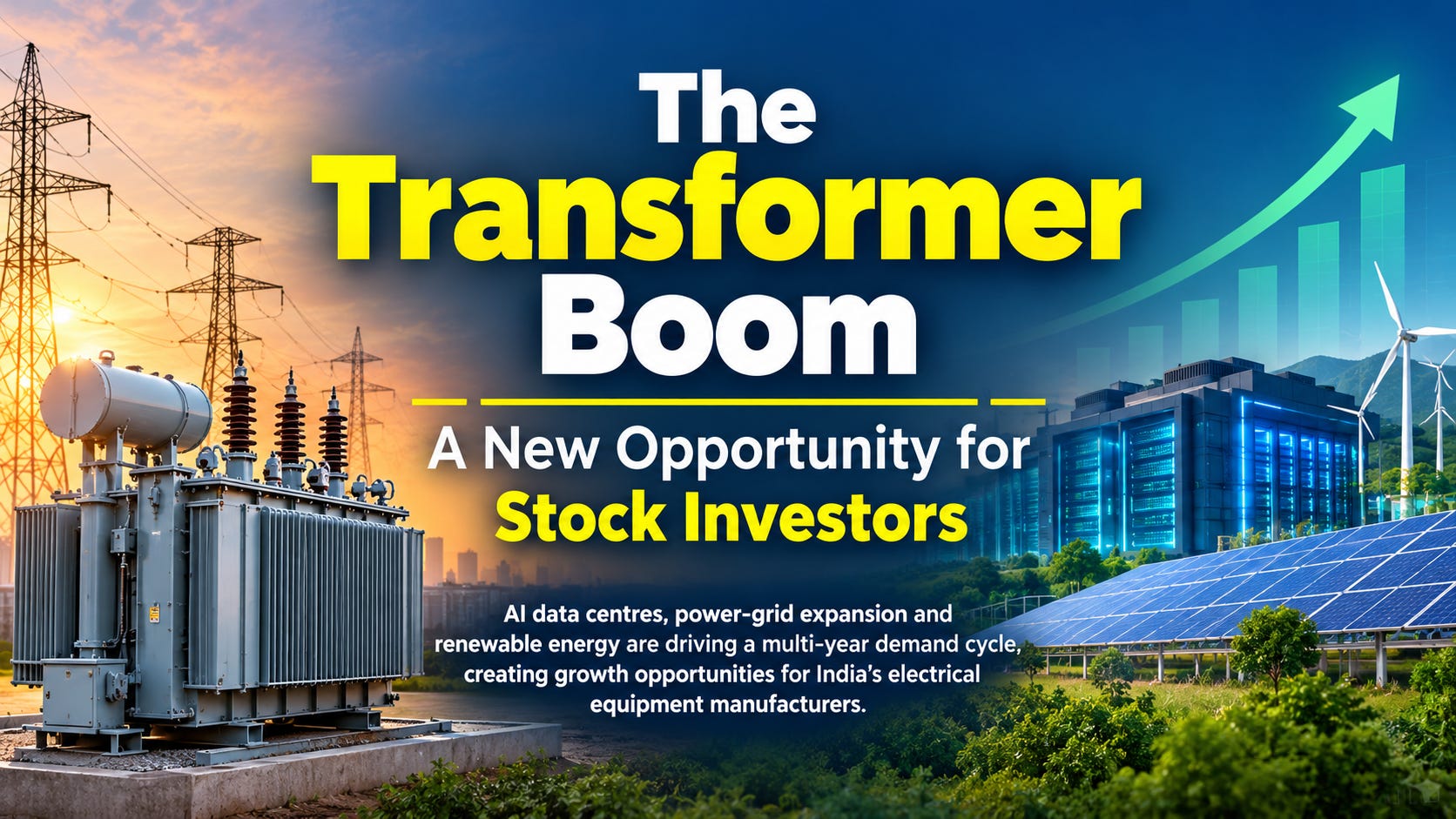
A Power Infrastructure Boom Is Taking Shape
The artificial intelligence revolution is creating an investment opportunity beyond semiconductor chips, software and data-centre operators. Every AI data centre needs reliable electricity, high-capacity transformers and robust power-distribution infrastructure. At the same time, renewable-energy integration, industrial electrification and ageing transmission networks are increasing the need for new and replacement transformers.
This convergence of demand drivers is creating the potential for a sustained growth cycle in the global transformer industry. For stock investors, the opportunity lies in identifying manufacturers capable of converting rising demand into profitable, cash-generating growth.
Demand Is Rising Faster Than Supply
Transformer manufacturing capacity cannot be expanded overnight, specialised equipment requires significant capital investment, skilled labour, testing facilities and customer approvals. Constraints in electrical steel and other components further complicate production.
Industry research published by McKinsey in September 2026 highlighted substantial transformer supply-demand imbalances in North America and Europe. Long delivery schedules and rising equipment prices indicate that the market remains constrained in several important segments.
Although manufacturers are adding capacity, supply may take time to catch up with demand. This creates opportunities for established producers with available capacity, strong technical capabilities and the ability to deliver complex, high-voltage equipment. However, shortages and pricing power vary across product categories and markets.
India: An Emerging Beneficiary
India offers an attractive combination of domestic demand and potential export opportunities. Transmission-network expansion, renewable-energy projects, industrial growth and the development of AI-ready data centres are increasing the importance of reliable power infrastructure.
Indian manufacturers are responding with capacity expansion. CG Power, for example, commenced production at its new Sehore facility in September 2026, initially adding 10,000 MVA of capacity, with a planned expansion to 45,000 MVA. Atlanta Electricals has also reported a substantial increase in manufacturing capacity and a sizeable order pipeline.
Transformers & Rectifiers is another company worth monitoring for its order-book growth and execution. Hitachi Energy India also provides exposure to the broader electrical-grid and high-voltage equipment opportunity.
These companies offer different combinations of product capability, scale, growth potential and valuation. Their prospects should therefore be assessed individually rather than treating the entire sector as a uniform investment opportunity.
What Should Stock Investors Look For?
A rising order book is an encouraging starting point, but do not automatically translate into higher shareholder returns. Investors should examine whether companies can execute orders on time, expand production efficiently, protect operating margins and convert reported profits into cash flow.
Capacity utilisation, working-capital requirements, debt, export opportunities and the quality of customer contracts deserve particular attention. Valuation is equally important: a company operating in a fast-growing industry can still deliver disappointing investment returns if its share price already reflects overly optimistic expectations.
Investors should also distinguish between manufacturers benefiting from specialised high-voltage demand and those competing in more commoditised segments, where pricing pressure may be greater.
A Long-Term Opportunity, but Selectivity Matters
The transformer industry is emerging as an important beneficiary of the global investment cycle in electricity infrastructure. AI-driven power consumption, renewable-energy integration and grid modernisation could support demand for several years, while manufacturing constraints may continue to favour capable producers.
For Indian stock investors, CG Power, Transformers & Rectifiers (India), Atlanta Electricals and Hitachi Energy India merit further research. The next step is to compare their latest financial results, order inflows, execution capacity, profitability and valuations to determine which companies offer the most attractive balance between growth and investment risk.
The central investment idea is straightforward: the AI opportunity is not confined to the companies developing computing technology. It also extends to the businesses supplying the electrical infrastructure that makes AI and modern power systems possible. The challenge for investors is to identify companies that can turn this structural demand into sustainable earnings growth without paying an excessive price for future expectations.
Disclaimer
This report presents an industry outlook and an analytical perspective for informational and educational purposes only. It is not investment advice or a recommendation to buy or sell any security. Investors should conduct their own research and assess company fundamentals, valuations, risks and suitability before making investment decisions.
ur capacity utilisation and working-capital points meet at transformers & rectifiers.. one plant ran at 57% on geopolitical supply issues despite enough orders, so they've stocked raw material till december and inventory is high for now