


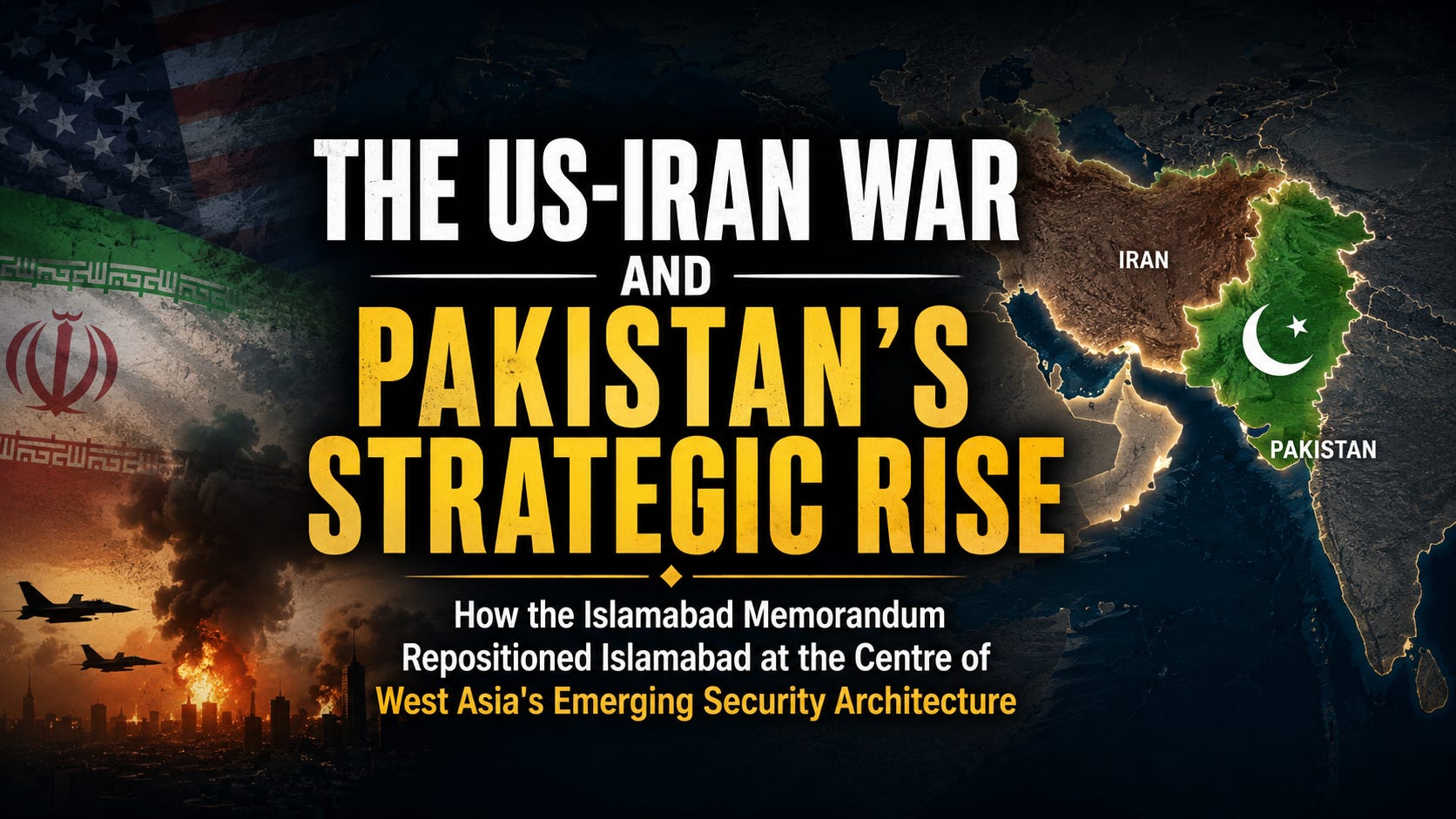
The geopolitical map of West Asia appears to be entering a period of structural realignment. The 2026 US-Iran conflict and the subsequent Islamabad Memorandum did more than end a dangerous military confrontation—they unexpectedly elevated Pakistan from a regional stakeholder to a diplomatic facilitator.
For decades, Pakistan was viewed primarily through the lenses of counter-terrorism, South Asian security and domestic political instability. Today, however, Islamabad is increasingly being discussed as a potential bridge between competing geopolitical blocs.
Unlike most regional powers, Pakistan simultaneously enjoys close defence ties with the Gulf monarchies, strategic cooperation with China, improving engagement with the United States, working diplomatic channels with Russia and an ability to communicate with Iran without carrying the political baggage of formal ties with Israel. Whether this represents a temporary convergence of circumstances or the beginning of a more enduring geopolitical role remains one of the most important strategic questions facing the region.
This report examines why Pakistan’s position has strengthened, where its advantages lie and what risks could prevent it from converting this diplomatic momentum into lasting strategic influence.
From Frontline State to Pivot Power
For much of the past two decades, Pakistan’s strategic importance was largely reactive. It was considered indispensable during the War on Terror but was rarely viewed as a country capable of shaping regional diplomacy. The Islamabad Memorandum has altered that perception.
By successfully facilitating dialogue between Washington and Tehran during one of the most dangerous regional crises in decades, Pakistan demonstrated an ability to engage multiple adversaries simultaneously. More importantly, it showed that major powers increasingly view Islamabad not merely as a security partner but also as a diplomatic intermediary.
This represents an evolution from being a frontline state to becoming a pivot state.
The Unique Nuclear Position
Pakistan occupies a strategic position unmatched by any other Muslim-majority nation.
It remains the only nuclear weapons state in the Islamic world.
Although not a member of the GCC, it has maintained decades-long defence relationships with Saudi Arabia and several Gulf monarchies.
Pakistani military personnel have trained Gulf forces, participated in defence cooperation and built institutional trust that predates many contemporary regional alliances.
This combination creates an unusual security equation. Pakistan provides strategic reassurance to Gulf partners without requiring a formal defence treaty, allowing Gulf states to diversify their security options while avoiding the political costs of creating a new alliance.
The Israel Factor: Strategic Neutrality in an Era of Polarisation
Pakistan remains among the few major Muslim-majority countries without diplomatic relations with Israel. While historically this position was often portrayed as a diplomatic limitation, recent regional developments have altered its significance.
Following the Iran war and the continuing Gaza crisis, Pakistan’s stance has enhanced its credibility across much of the Islamic world, allowing it to maintain dialogue with Tehran while preserving strong defence relationships with Gulf monarchies and constructive engagement with Washington.
In diplomacy, neutrality can sometimes become strategic capital.
The Three-Power Balancing Act
Perhaps Pakistan’s greatest strategic achievement today is maintaining simultaneous engagement with all three major global powers.
United States
Security cooperation
Counter-terrorism dialogue
CENTCOM engagement
China
CPEC
Defence cooperation
Long-term infrastructure investment
Russia
Energy discussions
Defence consultations
Expanding diplomatic engagement
Few countries today possess meaningful working relationships with Washington, Beijing and Moscow simultaneously. Rather than choosing one geopolitical camp, Pakistan increasingly appears to be positioning itself as a connector between competing power centres.
The Sharif–Munir Dual Architecture
One of Pakistan’s distinguishing characteristics is its two-centre decision-making structure.
Prime Minister Shehbaz Sharif represents the country’s formal diplomatic leadership.
Field Marshal Asim Munir represents Pakistan’s security establishment with extensive relationships across Gulf capitals and Western military institutions. Rather than functioning as competing centres of authority, recent events suggest both institutions have operated in a complementary manner.
This dual-track engagement allows Pakistan to negotiate simultaneously through diplomatic and military channels—a capability relatively few countries possess.
Pakistan and the GCC Security Equation
Although Pakistan is not a member of the Gulf Cooperation Council, its military relationship with GCC states remains one of the deepest outside the Arab world.
The relationship includes:
Military training missions
Intelligence cooperation
Joint military exercises
Air force collaboration
Defence advisory roles
Long-standing strategic trust
If Gulf states gradually seek greater strategic autonomy while reducing exclusive dependence on the United States, Pakistan could emerge as one of the most credible external security partners.
Rather than replacing the American security umbrella, Pakistan may increasingly function as an important complementary pillar.
Geography: Pakistan’s Enduring Strategic Advantage
Geography remains one of Pakistan’s strongest long-term assets.
It connects:
South Asia
Central Asia
Western China
The Arabian Sea
The Persian Gulf
Gwadar Port and the China-Pakistan Economic Corridor provide Islamabad with growing relevance in future trade, logistics and energy networks.
Should regional energy corridors expand in the coming decade, Pakistan’s geographic value could become even more significant than its military importance.
Islamabad Memorandum: More Than a Peace Agreement
The Islamabad Memorandum should not be viewed solely as a diplomatic document.
It represents proof that:
Islamabad can host high-level negotiations.
Rival powers view Pakistan as an acceptable intermediary.
Pakistan can contribute to regional crisis management.
Diplomatic credibility has become an additional strategic asset.
This could become the foundation for a broader mediation role in future regional disputes.
The Possibility of a “GCC-Plus” Security Architecture
One of the more intriguing long-term scenarios is the gradual emergence of a Gulf security framework that becomes less exclusively dependent on direct American military involvement. Should such an arrangement evolve, Pakistan possesses several comparative advantages:
Trusted military institutions,
Nuclear deterrence,
Operational experience,
Geographic proximity,
Established Gulf relationships.
While this remains speculative, Pakistan is arguably better positioned than any other non-GCC state to participate in such an architecture.
Implications for India
Pakistan’s expanding diplomatic engagement does not diminish India’s growing global influence. However, it does introduce a new strategic variable. New Delhi will closely monitor:
Expanding US-Pakistan military dialogue,
Pakistan-Gulf defence cooperation,
Chinese investments through CPEC,
Pakistan’s evolving mediation role.
The result is likely to be increased geopolitical competition rather than direct confrontation.
Economic Opportunities
Geopolitical influence alone cannot sustain great-power relevance. Pakistan’s long-term success depends upon converting diplomatic capital into economic gains through:
Infrastructure investment and logistics
Energy transit
Manufacturing
Gulf sovereign wealth investment
Regional connectivity,
Trade corridors.
Strategic relevance must ultimately produce economic resilience.
Risks to the Thesis: Several factors could limit Pakistan’s emerging influence.
Domestic
Pakistan’s strategic gains remain constrained by structural domestic challenges, including IMF dependence, fiscal pressures, political uncertainty, governance issues, and the persistent threat of terrorism. Unless these weaknesses are addressed, geopolitical relevance may not translate into long-term national strength.
Regional
Pakistan must balance a complex regional environment marked by tensions with India, instability in Afghanistan and the evolving dynamics between Iran and the Gulf states. Sustaining its role as a regional mediator will require careful management of these competing relationships.
Global
At the global level, intensifying US-China rivalry, evolving American engagement in the Gulf and shifting regional leadership could reshape Pakistan’s strategic space. Preserving balanced ties with competing powers will remain one of Islamabad’s key diplomatic challenges.
These risks suggest that Pakistan’s current momentum should be viewed as an opportunity rather than an assured strategic transformation.
Final Assessment
The Islamabad Memorandum may ultimately be remembered not merely as the agreement that helped conclude a regional conflict, but as the moment that redefined Pakistan’s geopolitical identity.
For decades, Pakistan was primarily viewed as a security challenge or a frontline state but today, increasingly being assessed as a diplomatic intermediary, a trusted military partner and a strategic bridge connecting Washington, Beijing, Moscow, Tehran and the Gulf monarchies.
Its unique combination of nuclear capability, geography, military relationships, diplomatic flexibility and access to multiple power centres gives Islamabad a degree of strategic optionality that few middle powers currently enjoy.
Whether this moment becomes a lasting geopolitical realignment will depend on Pakistan’s ability to institutionalise its diplomatic gains, strengthen its economy, maintain internal stability and continue balancing competing global interests without becoming overly dependent on any single partner.
If it succeeds, Pakistan may emerge not simply as an important regional actor, but as one of the defining pivot states of an increasingly multipolar world.
Let’s Talk
Geopolitics is constantly evolving and today’s strategic shifts could reshape tomorrow’s global order. Do you believe Pakistan is emerging as a lasting geopolitical pivot or is this merely a temporary realignment?
Share your thoughts—I’d love to hear your perspective.