


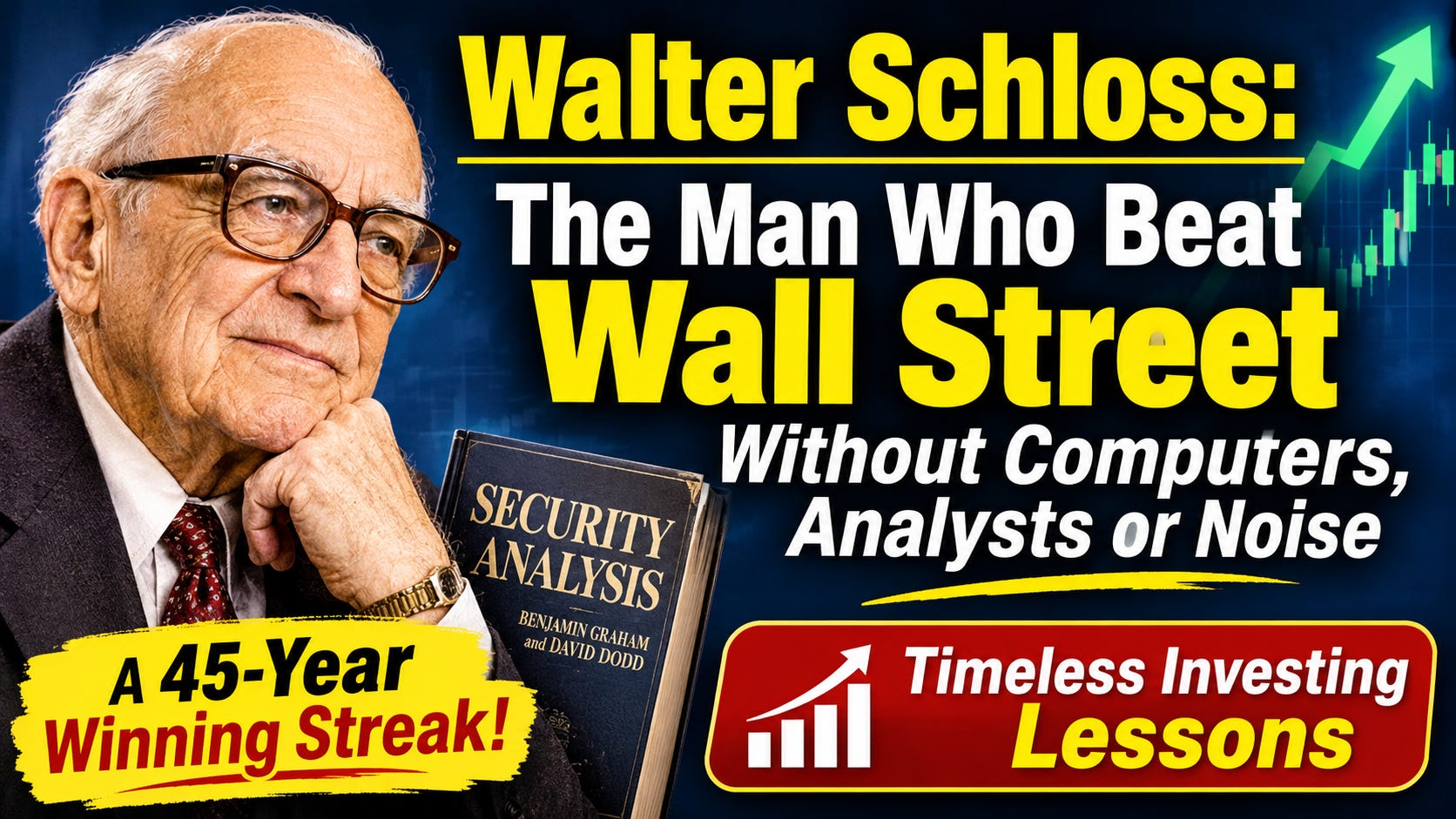
Does successful investing really require complexity?
Modern investing offers endless information, sophisticated tools and expert opinions. Yet Walter J. Schloss built an extraordinary investment record using simple financial analysis and disciplined value investing.
A student of Benjamin Graham and contemporary of Warren Buffett, Schloss preferred financially sound companies trading substantially below their underlying value.
Between 1956 and 2000, his partnership generated a compounded annual return of 15.3%, against 11.5% for the S&P 500.
His journey raises an important question: Can disciplined valuation, financial strength and patience outperform the constant pursuit of market favourites?
His investment philosophy offers some compelling answers.
From Wall Street messenger to legendary investor
Walter Schloss began his Wall Street career in 1934 as a runner at Carl M. Loeb & Co. His investment education came largely through self-study and Benjamin Graham’s classes, particularly after reading Security Analysis.
After serving in the US Army, he joined Graham-Newman Corporation in 1946, working alongside Warren Buffett. In 1955, he established his own investment partnership with approximately $100,000 and 19 investors. His son Edwin joined in 1973. The partnership continued until 2000. Schloss passed away in February 2012 at the age of 95.
What made Walter Schloss exceptional?
Warren Buffett highlighted Schloss’s investment record in his 1984 essay, The Superinvestors of Graham-and-Doddsville.
Between 1956 and the first quarter of 1984, Schloss’s limited partners earned an annual compounded return of 16.1%, against 8.4% for the S&P 500. The partnership’s return before general-partner allocations was 21.3%.
Over the longer 1956–2000 period, Ivey Business School records a 15.3% annualised return against 11.5% for the S&P 500.
Importantly, these are different measurement periods. Schloss also experienced losing years. His achievement was long-term outperformance, not 45 consecutive profitable years.
The investment thesis
Buy undervalued assets with a margin of safety
Schloss followed Benjamin Graham’s value-investing philosophy. Initially, he searched for companies trading below net working capital. Later, he expanded towards stocks trading below book value.
His investment thesis rested on six principles:
Buy undervalued businesses: Seek substantial discounts to underlying asset value.
Avoid excessive debt: Prefer financially strong companies with conservative balance sheets.
Investigate depressed stocks: Distinguish temporary difficulties from permanent business deterioration.
Verify asset quality: Examine goodwill, receivables, inventory and the actual value of reported assets.
Study insider ownership: Consider management’s financial commitment to the business.
Demand a margin of safety: Ensure potential returns justify the investment risks.
His central belief was simple: Buy something worth considerably more than its market price.
How did he select stocks without a research infrastructure?
Schloss relied on annual reports, financial statements and Value Line publications rather than sophisticated research infrastructure.
His checklist focused on:
Book value and asset quality.
Historical earnings and cash flows.
Debt and profit margins.
Ten-year price ranges.
Competitor performance.
Insider ownership.
Potential downside versus upside.
Diversification was central to his approach. His partnership often maintained around 100 positions and had owned more than 800 securities over its history.
His typical holding period was approximately four years. He accepted that some investments would fail, relying on diversification and disciplined selection to protect overall portfolio performance.
What can investors learn from Walter Schloss?
Schloss’s philosophy offers seven enduring lessons:
Price decline is not value: Investigate the business before buying a beaten-down stock.
Prioritise financial strength: Excessive debt can destroy shareholder value.
Respect valuation: Even excellent businesses can become poor investments at excessive prices.
Explore unpopular opportunities: Market pessimism can create attractive entry points.
Be patient: Undervaluation may take years to translate into returns.
Diversify sensibly: Accept that even good investment analysis can be wrong.
Keep the process simple: Avoid unnecessary complexity but never compromise on research.
Applying the Schloss philosophy for Indian Equities
Schloss’s philosophy can be adapted for Indian Equities through a disciplined screening process.
Look for companies with:
Attractive valuations relative to book value.
Low debt and healthy cash flows.
Quality assets and sustainable earnings.
Established operating histories.
Sound promoter credentials and corporate governance.
Attractive valuations relative to historical levels and competitors.
However, low price-to-book ratios alone are insufficient. Investors must investigate asset quality, receivables, obsolete inventory and possible governance problems.
Why the Schloss approach cannot be copied blindly
Schloss’s approach cannot be copied blindly.
Book value may be misleading, particularly in businesses with deteriorating assets, obsolete inventory or questionable receivables. It is also less useful for companies whose value depends primarily on intangible assets.
Low valuations can reflect genuine structural problems rather than market mispricing.
Investors must therefore examine business quality, governance and opportunity cost before investing.
The objective should be to adapt Schloss’s principles, not mechanically replicate his stock-selection rules.
Conclusion: The enduring advantage of disciplined investing
Walter Schloss demonstrated that successful investing does not require sophisticated systems or constant market predictions.
His approach rested on valuation, financial strength, diversification and patience.
His greatest lesson is that opportunity often lies where market attention is absent. However, an unpopular stock becomes attractive only when its underlying business value justifies the price.
In investing, identifying value matters more than following excitement. That is the enduring lesson of Walter Schloss.
Disclaimer
This report is for educational and informational purposes only. It does not constitute investment advice or a recommendation to buy or sell securities. Investments involve risks, including loss of capital. Historical returns do not guarantee future performance. Readers should independently verify all financial information before making investment decisions.